
How to Choose the Right Offshore Software Development Company
Most decisions about offshore software development come down to one moment: picking the company you're going to trust with your product. Get it right, and everything else (cost, speed, quality) follows. Get the partner wrong, and no amount of process fixes it.
This post covers what a proven track record actually looks like under scrutiny, how to read cultural alignment before a contract is signed, what to ask about team structure and data protection, and the patterns that consistently signal a bad fit.
Choosing the wrong offshore software development company is an expensive mistake to make. The right evaluation framework focuses on:
- Proven track record with verifiable client outcomes, not just case study PDFs
- Cultural alignment that reflects how your team actually works, not just stated values
- Communication style and async standards that hold up under delivery pressure
- Team structure and how engineers are sourced, vetted, and retained
- Data protection practices and contractual protections built into the engagement from day one
The Hidden Cost of the Wrong Partnership
The visible cost of a bad offshore partner is time and money. The hidden cost is institutional: burned trust in the offshore model itself, internal teams inheriting bad code, and hiring cycles that restart from zero.
Luckily, most of these outcomes are preventable. The issue isn't offshore development as a concept. It's that too many companies evaluate offshore software development companies the same way they'd buy software: features, pricing, timeline. Those are the wrong qualifiers.
The right evaluation starts by asking how a company actually works, not what they claim to deliver.
Read More: Offshore Software Development: Strategy & Models
What "Proven Track Record" Actually Means
A real track record for a software development partner includes:
Client tenure in context: how long clients stay matters, but the right question is whether tenure matches the engagement type. Some partners are specifically hired for defined projects, and a clean handoff is the intended outcome. What you're looking for is whether multi-year clients exist and whether short engagements ended because the work was done, not because the relationship broke down.
Documented delivery history: case studies are a starting point, not evidence. What were the actual outcomes? Did the product ship on time? What changed mid-engagement, and how did the team adapt?
Domain exposure: a track record in ecommerce isn't directly transferable to regulated fintech or distributed data systems. Ask how many engagements they've run in your specific domain and what the complexity looked like.
The clearest signal is how a vendor responds when you ask for specifics. Companies with a genuine track record can speak concretely to outcomes, timeline changes, and what went wrong on past engagements. Those without one tend to keep everything polished and at arm's length.
Cultural Alignment Is Not About Shared Values Statements
Most vendor proposals include something about being "collaborative," "proactive," or "aligned with your goals." That's marketing. Cultural alignment, the kind that determines how a team behaves under pressure, looks different.
It shows up in:
How engineers handle ambiguity: do they ask clarifying questions or ship what was written?
Attitudes toward code quality: is technical debt flagged proactively or silently accumulated?
Response to disagreement: can the team push back on a bad architectural decision, or do they execute blindly?
The most useful signal is a technical conversation before any contract is signed. Not a demo, an actual working session where you give a realistic problem and watch how the team approaches it. Those thirty minutes will tell you more than a month of sales calls.
Offshore software development teams that are genuinely aligned with how you work will treat that session as an opportunity instead of an obstacle.
Communication Under Real Conditions
Communication standards matter in all directions: written, verbal, synchronous, and async. What matters is how their communication style holds up when a requirements document is ambiguous, when a deadline shifts, or when a critical bug surfaces at 4pm on a Friday.
The most reliable way to evaluate this before signing anything is to review written artifacts from the team directly. Ask for PRDs, architectural notes, or ticket summaries from a recent engagement. How engineers write about technical problems tells you a lot about how they think, and how much hand-holding your internal team will need to do in practice.
Beyond the written layer, run a live technical discussion on video before any contract is signed. Then ask specifically how they handle async communication when time zone gaps make real-time collaboration difficult. Teams that have thought about this will have a clear answer. Teams that haven't will describe a process that falls apart the moment anyone is offline.
How the Team Is Structured
When an offshore vendor quotes a team, you need to know what's behind it.
Key questions on structure:
Are engineers dedicated to your project, or shared across multiple clients?
Who owns technical leadership on your engagement: a project manager or a senior engineer?
What is the retention profile of the team? High turnover offshore means knowledge walks out the door repeatedly.
How are engineers sourced and vetted internally?
The difference between a team that ramps once and retains knowledge versus one that cycles through junior engineers is the difference between shipping on time and rewriting the same module four times.
Questions That Reveal the Most
Most vendor calls spend too much time on pricing and too little on process. These questions cut through faster:
"How do you handle disagreements with a client's technical direction?"- You want a team that can say no with a reason, not one that defers to avoid conflict.
"Walk me through how you handled a delivery that went wrong."- Every good team has a failure story. Companies that don't have one haven't worked hard enough, or aren't telling the truth.
"How do you structure onboarding when joining an existing codebase?"- This reveals process maturity. Strong offshore partners have a documented approach. Weak ones improvise.
"What does your escalation path look like when a sprint is at risk?"- You want early visibility, not end-of-sprint surprises.
"How do you manage intellectual property and data access controls?"- This should have a clear, specific answer. Vague responses here are a signal worth taking seriously.
Data Protection and Contractual Foundations
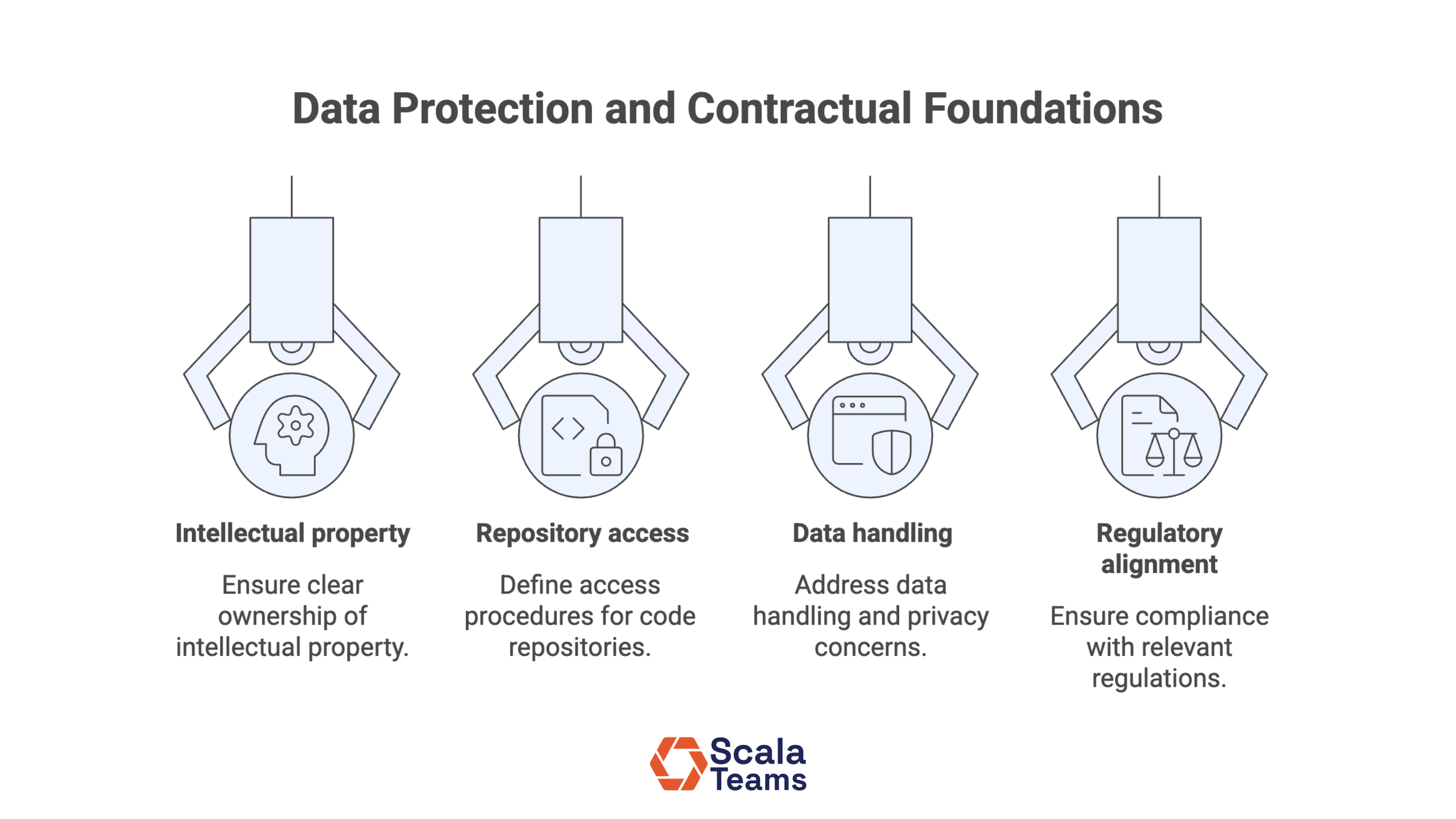
Offshore engagements introduce compliance considerations that are easy to defer and expensive to fix after the fact. Intellectual property ownership, repository access, data handling, and regulatory alignment all need to be addressed before any code is written, not during the first security review or when the engagement ends.
The specifics worth pressing on: code ownership clauses in the master service agreement, access revocation procedures when the relationship winds down, security policy documentation and whether it's available for audit, and NDA scope and enforceability across the relevant jurisdictions. The contractual foundation determines whether you actually own what gets built.
Experienced offshore software development companies have clear, established data protection practices and share their security posture. If a vendor treats these questions as a negotiation rather than a standard part of onboarding, that tells you something.
Red Flags Worth Walking Away From
Some patterns consistently predict failed engagements:
Low estimates with aggressive timelines: this usually means the team hasn't actually scoped the work
Resistance to a pre-contract technical session: companies confident in their team don't avoid scrutiny
All communication routed through a project manager: limited engineer access before signing often means limited access after
Vague answers on team composition: if you can't find out who will actually be working on your project, that's the answer
No documented process for handoffs or transitions: offshore engagements eventually end or evolve; the lack of transition planning is a delivery risk
Experiencing one of these isn't a disqualifier on its own. However, combined, they form a pattern worth carefully weighing.
Choosing an Offshore Partner Is a Process, Not a Decision Point
The companies that build successful offshore partnerships don't pick the best proposal. They run a structured evaluation, talk to the engineers, validate the track record, and negotiate the contractual foundations before code is written.
If you're working through cost structure alongside vendor selection, our breakdown of offshore development costs will give you a better picture of what drives pricing and where the real value differences lie.
If you've already identified the kind of technical expertise you need, the next step is understanding how to find and evaluate skilled offshore developers before you start any engagement.
Scala Teams specializes in placing dedicated Scala engineers and teams with companies that need technical depth, not just headcount. Start a conversation with Scala Teams to see how we structure offshore Scala development partnerships.
