
The Advantages of Outsourcing Full-Cycle Scala Development
Many teams rely on Scala for performance, reliability, and long-term growth, but hiring the right developers often slows progress. Recruiting takes time, onboarding pulls internal engineers away from active work, and product plans stall while the team searches for specialized skills. Outsourcing full-cycle Scala development gives companies another option. The right partner brings engineers, workflow, and delivery practices already in motion, so projects move without the delays that come with internal hiring.
This blog explores why companies choose to outsource Scala projects and how it supports faster delivery, stronger system stability, and clearer long-term strategy.
How In-House Hiring is Different From Outsourcing for Scala Development
In-house hiring builds team capacity inside the company. This includes sourcing, interviews, testing, onboarding, and internal management. It requires time from engineering leads, HR, and product owners. Even after a new hire begins, the team needs time to settle into the codebase.
Outsourcing works differently. A partner begins with an operating rhythm already in place. The team plans, builds, tests, deploys, and maintains the system as one unit. The hiring company does not carry recruiting cycles, turnover risk, or management load. Instead, the focus shifts toward goals, timelines, and outcomes.
The difference is clear once the work starts. Internal hiring builds long-term staffing power, but outsourcing Scala development moves projects forward without long lead time.
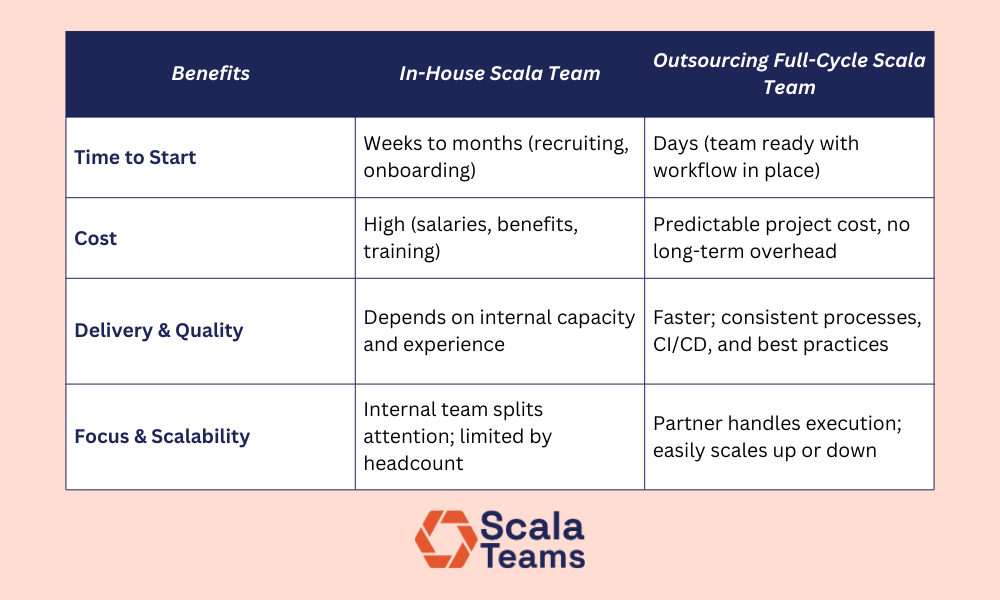
How to Choose the Right Outsourcing Model
The right model depends on team structure, roadmap size, and internal pressure. Some teams only need extra hands, so a staff-extension model fits. Others want a dedicated group that supports product work while internal leaders set direction. Some want end-to-end ownership so the partner handles planning, architecture, engineering, QA, DevOps, and long-term support.
The choice becomes simpler when the team looks at its own limits. If the roadmap has large gaps, if the team loses time to system fire drills, or if hiring slows every initiative, then a full-cycle model removes that friction. The company gains execution power without taking on new roles or training cycles.
How Outsourcing Raises Delivery Speed
Speed comes from removing startup delays. A development partner starts as soon as scope is clear. There is no recruiting funnel and no ramp-up period. The team is already comfortable moving through planning, engineering, testing, and deployment.
Parallel work is a major factor. Internal teams often move in a linear path because bandwidth is tight. A full-cycle group handles multiple streams at once. While engineers build features, QA tests earlier work, and DevOps prepares release steps. This flow shortens roadmaps, especially for features, migrations, and integration projects.
Outsourcing also reduces context switching. Internal engineers stay focused on strategic work, while the partner handles execution. This keeps forward motion steady and predictable.
Read More: Project Delivery Best Practices
How Outsourcing Lowers Total Cost
Cost savings do not only come from lower rates. They come from the removal of internal overhead. Hiring requires sourcing, interviews, HR work, equipment, training, and long-term payroll. Turnover adds even more cost.
An outsourced partner removes those steps since businesses pay for the work, not the entire employment cycle. Budget planning becomes easier because the cost stays consistent. This stability helps product teams commit to larger initiatives without worrying about staffing gaps or hiring delays.
Outsourcing Scala development also helps avoid skill fragmentation. Companies no longer need extra hires for specialized tasks like DevOps work, large refactors, or build-system updates. The partner covers these responsibilities inside the same engagement, which reduces tool and staffing load.
Read More: Offshore Scala Development Costs
How Outsourcing Improves Output Quality
Scala systems need consistent patterns, sound architecture, and reliable workflows. A partner brings these elements from day one. Engineers follow shared patterns. Reviews follow the same process. Testing and deployment run through defined steps. This consistency reduces regressions and raises system stability.
Another advantage comes from repeated exposure to many Scala systems. A partner sees patterns that internal teams encounter only once every few years. This helps identify choices that reduce long-term risk and prevent common pitfalls.
Quality also improves because the partner acts as a unified unit. The team discusses tradeoffs, designs, and risks together. This avoids fragmentation that can happen when a company hires several individuals over time with different experiences and habits.
How Outsourcing Strengthens Product and Platform Strategy
A full-cycle partner does more than write code. The partner helps shape long-term direction. Architecture reviews, planning sessions, and roadmap discussions move faster because the partner supplies insight from many systems.
This setup frees internal leaders. The CTO can focus on platform vision. Product managers can shape the roadmap. Internal engineers can work on critical features or cross-team initiatives. The partner handles delivery, support, and improvements that keep the system moving.
This division of work gives the company a strong rhythm where internal leaders set goals, and the partner executes against them.
When Outsourcing Delivers the Best Results
Outsourcing works well when a team faces constraints that slow progress. If the team lacks Scala experience, a Scala development partner fills the gap. If the roadmap grows faster than the staff can handle, a partner expands capacity. If legacy work blocks new features, a partner handles modernization while the internal team focuses on the product.
Full-cycle development models also benefit teams that need stable, steady output. Many companies lose momentum during turnover or org changes. An external team provides continuity so the roadmap stays on track.
Read More: How to Choose the Right Scala Development Outsourcing Partner
Deciding if Full-Cycle Scala Outsourcing Fits Your Team
Outsourcing full-cycle Scala development gives companies a direct path to progress. It removes hiring delays, reduces cost, increases quality, and strengthens product strategy. Internal teams keep control of direction while the partner delivers consistent execution. For companies that want to move faster without expanding internal staffing overhead, a full-cycle partner is a practical option.
Ready to accelerate your Scala projects? Fill out the form below and our team will reach out to set up a short discovery call.
