
Why Businesses Are Choosing Scala in 2026
Enterprise teams building fintech infrastructure and real-time data pipelines keep landing on Scala in 2026, not because it's trendy, but because type safety and JVM performance still solve real production problems. The bigger story isn't whether Scala is relevant. It's that fewer engineers know it well enough to hire for.
Scala remains in active use in 2026, especially in fintech, data engineering, and real-time systems where type safety and JVM performance matter. Adoption is steady, not explosive, and the real constraint isn't relevance. It's a shrinking pool of engineers who know the language well.
The Key Benefits of Scala for Data-Intensive Applications
In 2026, Scala continues to be one of the top languages for building high-performance, reliable, and data-driven systems. Its combination of functional programming, strong type safety, and integration with JVM-based frameworks allows developers to write scalable code. Scala provides an efficient foundation for enterprise applications when handling complex computations, ensuring system correctness, and processing large volumes of data.
High Performance for CPU-Intensive Applications
Scala’s compiled JVM code delivers performance comparable to Java while supporting advanced concurrency and parallelism. Multi-threading capabilities allow applications to handle high-throughput workloads, such as real-time analytics and simulation and scientific computing, with ease. Lazy computation is another lever. Scala defers evaluation until it's needed, which reduces unnecessary overhead in data-heavy pipelines.
Scala’s performance allows businesses to build reliable applications that process large volumes of data, making it a preferred choice for performance-critical systems.
Strong Type Safety for Reliable Enterprise Code
Scala’s advanced type system, including type inference, union types, and opaque types, reduces runtime errors and enforces compile-time checks. This ensures that enterprise applications are more reliable, maintainable, and scalable.
For large and complex codebases, strong type safety helps teams refactor code, preventing bugs that disrupt critical business operations.
Scalable Data Processing for Modern Workloads
Scala integrates seamlessly with frameworks like Apache Spark and Akka Streams, making it ideal for both batch and real-time data processing. Companies use Scala to build robust ETL pipelines, streaming applications, and distributed systems that handle massive datasets efficiently.
Industries Adopting Scala for Development in 2026
A growing number of industries are adopting Scala in 2026 for new projects due to its ability to handle complex, large-scale, and mission-critical systems. Its combination of performance, type safety, and functional programming makes it ideal for organizations with high data volumes, stringent reliability requirements, and advanced computational needs. From finance to enterprise data pipelines, Scala provides the tools to build robust systems that are efficient and safe.
Financial Services
Finance relies on low-latency, high-performance systems. Scala’s type safety and concurrency support make it a top choice for trading platforms, risk modeling, and transaction processing where precision and reliability are critical.
Enterprise Data Pipelines
Businesses with large-scale data workflows adopt Scala for ETL and analytics pipelines. Its type-safe transformations and integration with Spark allow teams to manage complex data flows without sacrificing reliability.
Real-Time Streaming Systems
Scala supports event-driven architectures and high-throughput messaging systems. Companies in media, ecommerce, and IoT rely on Scala to process streaming data in real time, enabling instant insights and automated responses.
CPU-Intensive and Computational Workloads
Scala handles computation-heavy tasks efficiently, from AI preprocessing to scientific simulations. Its performance and functional programming features allow developers to write concise, reusable, and reliable code for demanding applications.
Why Scala Remains a Top Choice
Choosing the right language shapes how well your team can scale, debug, and deliver over time. Scala is a top choice for many projects due to its expressiveness, reliability, and ecosystem maturity. Its functional programming capabilities, advanced type systems, and JVM compatibility allow organizations to tackle complex, data-intensive, and performance-critical applications with confidence. Scala’s evolving libraries and tools ensure it remains relevant, making it a strategic choice for both new projects and ongoing enterprise development.
Expressive and Functional Language
Scala combines object-oriented and functional programming paradigms. Its expressiveness allows developers to write concise, reusable, and highly maintainable code.
Handles Complex, Data-Intensive Applications
Scala is ideal for enterprise systems that require advanced type systems, mathematical computation, and high-performance data processing. Its strong ecosystem, including libraries, frameworks, and tooling, supports large-scale enterprise development.
Mature and Actively Evolving Ecosystem with Scala 3
Scala 3 continues to refine syntax, semantics, and library support. With frequent updates and new libraries released often, Scala remains at the forefront of enterprise-grade programming languages.
JVM Compatibility
Scala runs on the JVM, making it compatible with existing Java infrastructure and enterprise systems. This allows organizations to integrate it into current environments without major rewrites.
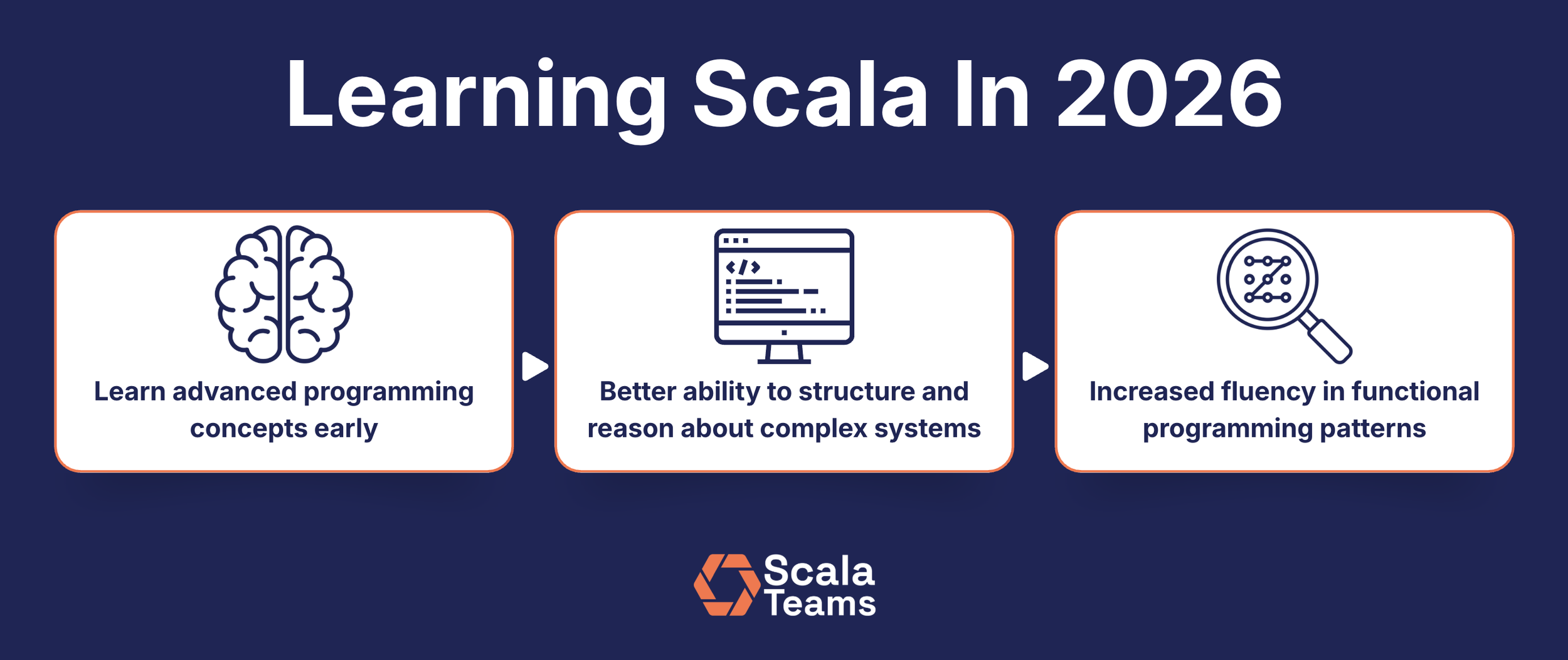
Learning Scala in 2026
While Scala has a steeper learning curve compared to mainstream languages, mastering it offers unique advantages:
Internalizing advanced programming concepts early
Improving the ability to structure and reason about complex systems
Gaining fluency in functional programming patterns increasingly adopted in other languages
For businesses that want to skip the internal training demands and launch projects quickly, partnering with a Scala-focused agency is the most efficient solution.
Outsourcing Scala Development
Hiring in-house Scala talent can be challenging due to the small talent pool. Outsourcing Scala projects gives companies access to experienced developers who understand the language, ecosystem, and best practices.
Benefits of outsourcing Scala development include:
Immediate access to Scala specialists
Faster project startup and reduced onboarding time
Avoid high in-house recruitment cycles
Minimized errors and delays in complex projects
For businesses aiming to launch Scala applications quickly, partnering with an experienced Scala development team is more efficient than building internal expertise from scratch.
Scala Teams specializes in helping businesses get their projects started quickly. Our senior-level Scala developers hit the ground running, implement best practices, and ensure projects are delivered reliably and on schedule.
Read More: How to Choose the Right Scala Development Outsourcing Partner
Scala’s Relevance in 2026
If you’re asking “Is there a future with Scala?” the answer is yes. Adoption trends back this up across enterprise and data engineering teams. Its performance, type safety, functional capabilities, and mature ecosystem make it a strong choice for enterprise, data-intensive, and high-performance projects in 2026.
Whether you’re building large-scale data pipelines, real-time streaming systems, or computationally heavy tools, Scala provides the depth, reliability, and expressiveness necessary to succeed. Get in touch, or leave your details below, and our team will follow up to set up a short discovery call.
Get in Touch
Frequently Asked Questions
Is Scala still relevant in 2026?
Yes. Scala is actively used in fintech, data engineering, and distributed systems where type safety and concurrency handling matter. Adoption has stabilized rather than grown explosively, but usage in production systems remains strong.
Is Scala dead?
No. Scala continues active development with Scala 3, and companies in finance and data-intensive industries rely on it for production systems. The perception of decline comes from a shrinking talent pool, not from companies abandoning the language.
Is Scala still used in 2026?
Yes, particularly in enterprise data platforms, real-time streaming systems, and financial services backends where JVM performance and type safety are priorities.
What is Scala used for?
Scala is used for building high-performance, data-intensive systems including fintech backends, real-time streaming pipelines, and large-scale data processing platforms that require both speed and reliability.
