
When Scala Is the Wrong Choice
Every language has a pitch. Scala's is real, type safety, concurrency, JVM performance, and most of the content written about it, including plenty on this site, makes that case well. What almost nobody writes about are the Scala limitations that make it the wrong choice for a meaningful number of projects, and pretending otherwise doesn't do your team any favors.
This isn't a takedown. It's a straight look at where Scala's strengths stop mattering, where a different language actually serves the project better, and where the calculus flips back in Scala's favor.
Scala isn't the right choice for small teams without JVM experience, fast MVPs, simple CRUD applications, or early-stage startups where hiring risk outweighs long-term performance gains. Python, Node, and Go often serve these situations better. Scala earns its complexity when a system genuinely needs strong typing, concurrency, and JVM-scale reliability, not by default.
The Scala Limitations That Actually Matter for Your Project
Most discussions of Scala's tradeoffs stay abstract: it's harder to learn, the talent pool is smaller, the ecosystem is less mainstream. True, but not useful on their own. What matters is how those tradeoffs interact with your specific situation. A steep learning curve barely registers for a well-funded enterprise team with time to onboard. That same curve can stall a five-person startup for a full quarter. A smaller talent pool is a minor inconvenience if you're not hiring right now, and an existential risk if a key engineer just gave notice.
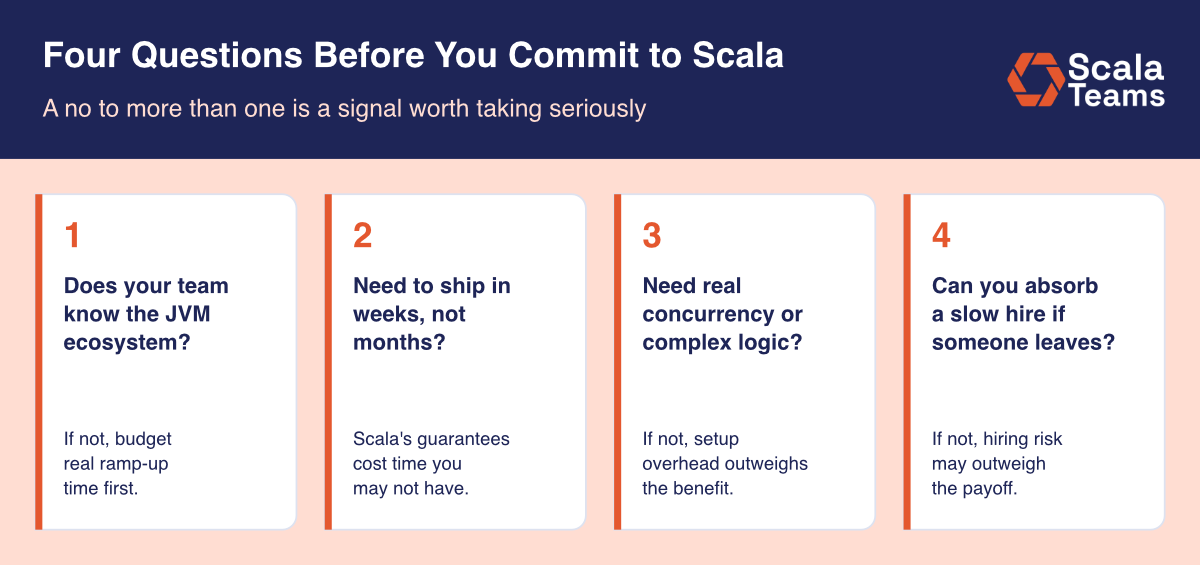
The four questions worth asking before committing to Scala are these: does your team already know the JVM ecosystem, does the project need to ship in weeks rather than months, does the system actually require heavy concurrency or complex domain logic, and can your company absorb a slow hiring cycle if a Scala specialist leaves. A no to more than one of these is a signal worth taking seriously.
Small Teams Without JVM Experience Pay a Real Onboarding Cost
Scala has a learning curve steeper than most mainstream languages, and that curve costs real time for a team that doesn't already know the JVM ecosystem. Given and using clauses, variance annotations, and effect systems like Cats Effect or ZIO take weeks to get comfortable with, even for strong engineers coming from Python or JavaScript. These aren't cosmetic syntax differences. They change how a team reasons about dependency injection, error handling, and side effects at a fundamental level, and that shift in mental model is what actually costs the time, not memorizing new keywords. A team of five spends its first sprint cycle learning the language instead of shipping the product, and that cost lands before any of Scala's benefits show up.
This isn't a knock on the engineers. It's a mismatch between team background and language demands, and it shows up fastest on teams that skipped Java or Kotlin entirely.
When Python Is the Better Starting Point
If your team already knows Python and the project doesn't require heavy concurrency, staying in Python avoids the ramp-up cost entirely. Frameworks like Django or FastAPI let a team with existing Python experience move directly into building features instead of learning a new type system and a new runtime at the same time. The tradeoff shows up later, in scaling limits and looser type guarantees, but for a team optimizing for immediate velocity over long-term architecture, that tradeoff is often worth making.
Fast MVPs Do Not Need Scala's Guarantees
Scala's type system exists to catch problems in large, long-lived codebases where a small mistake can ripple through years of accumulated logic. An MVP doesn't have that problem yet. It has a different one: does anyone want this product at all. Betting weeks of setup time on a language chosen for scale you don't have yet is a bad trade when the real risk is building the wrong thing entirely.
When Node Is a Better Choice Than Scala
For an MVP where the goal is a working product in front of users as fast as possible, Node's ecosystem and minimal ceremony get a team there faster. A single JavaScript or TypeScript codebase across frontend and backend cuts the number of languages a small team has to context-switch between, and the npm ecosystem covers most common MVP needs without custom tooling. Scala's compile-time guarantees matter far more once the product has users and the codebase has to survive years of iteration, not during the first month of finding out if it should exist at all.
Simple CRUD Applications Rarely Justify the Overhead
Not every application deals with high concurrency, complex domain logic, or JVM-scale data processing. A straightforward CRUD app, a basic internal tool, or a low-traffic admin dashboard doesn't stress-test any of the problems Scala was built to solve. Building one in Scala means writing more boilerplate to set up a project than the application itself will ever need, and it means configuring SBT, resolving dependency versions, and wiring up a web framework like Play or http4s before a single business rule gets written. That setup tax is the same whether the app has ten users or ten million, which is exactly the problem when the app was only ever going to have ten.
When Ruby or Python Frameworks Fit Better
A basic internal dashboard or admin tool is a textbook case for Rails or Django. Both give a team a working CRUD interface with authentication, routing, and database models configured in a day, not a sprint. Scala has no equivalent batteries-included framework for this exact use case, because it wasn't built to solve it. Reaching for Scala here adds setup time and cognitive overhead with no corresponding payoff in reliability or performance, since the application was never going to stress either one.
Early-Stage Startups Often Cannot Absorb the Hiring Risk
The talent pool for Scala is smaller than for most mainstream languages, and that scarcity matters differently depending on company stage. A well-funded enterprise team can plan around a longer hiring cycle and absorb a vacant role for a few months without the business stalling. An early-stage startup often cannot. A smaller candidate pool means a longer search by definition, and a startup running on a tight runway doesn't have the slack to wait out that gap the way a larger company can. If a founding engineer who knows Scala leaves, the company is left choosing between a slow, expensive search for a replacement or a costly rewrite in a more common language, and neither option is available on startup timelines.
When Go Solves the Hiring Problem Scala Creates
Go was built partly to solve this exact problem: a smaller, easier-to-learn language with a talent pool deep enough that hiring isn't a constant risk. For a startup building backend services that need real performance but not Scala's functional programming depth, Go delivers strong concurrency support through goroutines with a language most backend engineers can pick up in weeks, not months. It won't give a team Scala's type system or its expressiveness, but it removes the single-point-of-failure hiring risk that early-stage companies can least afford.
When Scala's Complexity Is Worth It
None of this means Scala is a poor language. It means Scala is a specialized one, and specialization only pays off when the problem matches it. The case for Scala gets stronger as systems grow more complex, as concurrency becomes a real production requirement, and as the cost of a runtime failure gets higher than the cost of a slower ramp-up.
A fintech platform processing transactions at scale, a data pipeline running real-time analytics through Spark, or an enterprise system with years of expected lifespan all justify the investment Scala asks for. In these cases, the type system that felt like overhead on a CRUD app becomes the thing preventing a six-figure production incident, and the concurrency model that felt unnecessary for an MVP becomes the reason the platform survives a traffic spike instead of falling over.
Consider two companies building a payment processing feature. One is a three-person startup validating demand for a niche product, the other is a Series C company processing millions in transaction volume with a dedicated compliance team. The first company should be shipping something in Node or Python this month, not debating implicits. The second is exactly where Scala's type system and concurrency model start paying for themselves, since a single unhandled edge case at that volume costs far more than the ramp-up ever would.
The difference between these cases and the ones above isn't Scala's quality. It's whether the problem actually needs what Scala is built to do. Good engineering leadership means knowing which category a project falls into before committing to a language, not defaulting to whatever a team knows best or whatever sounds most impressive in a pitch deck.
Not sure which category your project falls into?
If your system is heading toward the complexity Scala is built for, it's worth a second opinion before you commit. Talk to a Scala expert.
Frequently Asked Questions
What are the main limitations of Scala?
The steepest limitations are a longer learning curve for teams new to the JVM ecosystem, a smaller talent pool than mainstream languages, and setup overhead that isn't worth it for simple applications. These matter most for small teams, fast-moving MVPs, and early-stage startups.
Is Node a better choice than Scala for an MVP?
For most MVPs, yes. Node's minimal setup and single-language stack across frontend and backend get a working product in front of users faster, which matters more at the MVP stage than the type safety and concurrency guarantees Scala provides.
Why do startups sometimes choose Go over Scala?
Go offers strong concurrency support with a much smaller learning curve and a larger talent pool, which reduces the hiring risk that early-stage startups often cannot absorb if a Scala specialist leaves the team.
Does a simple CRUD application need Scala?
No. Frameworks like Rails or Django handle basic CRUD applications with far less setup than Scala requires, since these applications rarely need the concurrency or type-safety guarantees Scala was built to provide.
What are the biggest Scala limitations for a startup specifically?
The steeper learning curve and smaller talent pool hit startups hardest, since both can stall a project when time and hiring flexibility are already tight, in a way a larger, better-funded team could absorb.
