
Hiring Offshore Developers for Specialized Roles: A Skills-First Guide
Most offshore hiring guides assume you need volume, a few capable engineers to handle a backlog, ship features, and keep the lights on. They tell you where to post, how to screen, and what rates to expect. That advice works fine if you are filling commodity roles.
It does not work when you are trying to hire offshore developers who understand niche languages, functional programming, or the kind of domain-specific architecture that takes years to develop. The playbook breaks down, screening questions don’t have enough depth, and the candidates look similar on paper. The hire you eventually make disappoints in ways that are hard to articulate until the codebase shows it.
This post is written to help when the skill sets you need are specific, where niche expertise matters to your product, and when getting the hire wrong is expensive in ways that go beyond a wasted month.
Standard offshore hiring advice is built for generalist engineering roles. When you need specialized technical depth, the process has to change.
- Specialized offshore talent exists but it requires a targeted search, not a volume play
- Evaluating depth means testing architecture decisions and production judgment, not just code output
- Niche expertise requires higher rates, and the math still works. But only if you are honest about what the role actually requires
- The offshore market for skilled developers in functional programming, data systems, and cloud-native architecture is deeper than most companies expect
- A specialized hire shapes the standards every hire after them will follow
Why the Standard Offshore Playbook Breaks Down
Oftentimes, the offshore hiring process goes like this: write a job description, post it broadly, screen for keywords, run a technical test, and make an offer. For mid-level generalist roles, this works reasonably well. The population is large enough that even a blunt filter surfaces decent candidates.
For specialized roles, the same process produces the opposite result. The candidate pool shrinks, but the noise doesn’t. You get engineers who have some familiarity with the right technologies but not the depth to work with them independently. While the keyword match is there, the substance isn’t.
For example, a developer who understands Scala syntax is not the same as one who has built production systems using Akka or ZIO. A developer who has used AWS is not the same as one who has designed a fault-tolerant, cloud-native architecture from scratch.
Fixing this is not about working harder at the same process. It is about running an entirely different process.
What Specialized Offshore Talent Looks Like
The offshore market for skilled developers with deep technical expertise is larger and more capable than most companies expect. The gap is usually in how companies search, not in whether the talent exists.
Here is where genuine depth is available if you know how to find and evaluate it:
Functional and Systems Programming
Engineers with extensive fluency in languages like Scala and Haskell are a small global group and not concentrated in any one region. The offshore market has strong developers, particularly in Eastern Europe and parts of South and Southeast Asia, with academic foundations in type theory, category theory, and formal reasoning.
The signal is in how they talk about trade-offs. Ask them to compare approaches to managing side effects, why they would reach for ZIO over Cats Effect in a given context, or what they would avoid about each. A developer with practical experience has opinions, while a developer with surface familiarity hedges everything.
Distributed Systems and Data Architecture
Engineers who have built and operated systems at scale, like Kafka pipelines, Spark jobs, event-sourced architectures, and high-throughput APIs, represent a growing offshore talent pool. The specialization here comes from production exposure. You are looking for people who have debugged consumer lag at 3am, rethought a schema mid-migration, or redesigned a pipeline because the upstream data changed shape unexpectedly.
This experience is verifiable. Ask for the hardest production problem they have ever diagnosed, what assumptions broke, and what they changed as a result. The answer tells you more than any technical screen.
Cloud-Native Infrastructure and Platform Engineering
Platform engineers who understand Kubernetes internals, Terraform at scale, and the operational realities of multi-region cloud deployments are in demand everywhere, which means the offshore supply grew to match it. The best of them have strong opinions on failure modes, runbook discipline, and the places where automation becomes a liability instead of an asset.
For teams that need technical expertise in machine learning and cloud-native systems, this is a hire that can reshape how your entire engineering organization operates.
Domain-Specific and Niche Expertise
Niche expertise in areas like compiler tooling, formal verification, event sourcing and CQRS patterns, or specific framework internals is available offshore at a level that is genuinely hard to find locally in many areas. The pool is smaller, the search takes longer, and the right candidate is less likely to appear through a broad posting.
How to Evaluate Technical Skills When You Hire Offshore Developers
The evaluation frameworks most teams use were designed for output measurement: can this person write a function, pass a test, implement a feature? Those questions tell you almost nothing about whether someone has the technical expertise to make architectural decisions, navigate ambiguity, or mentor the people around them.
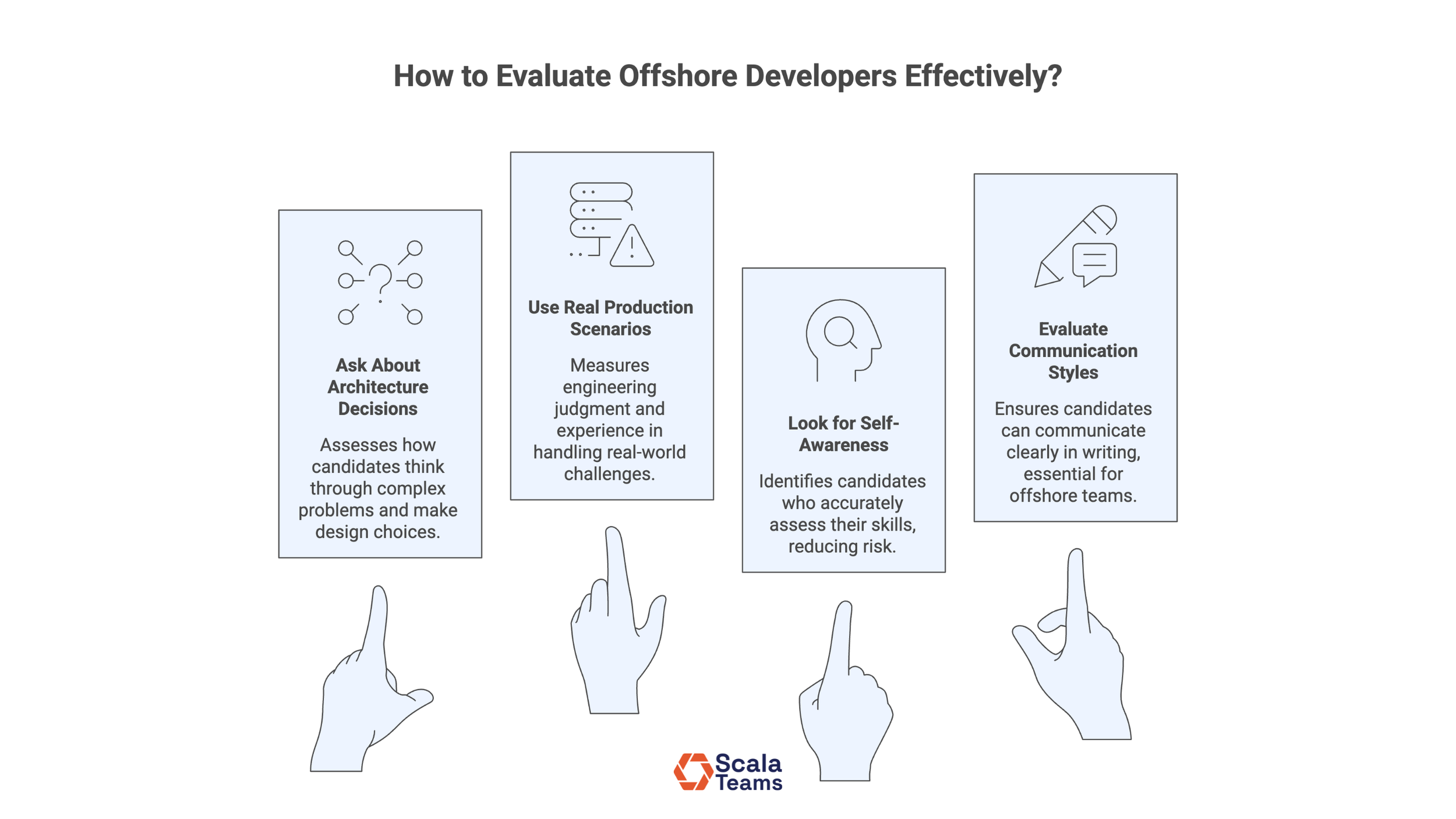
Ask About Architecture Decisions
Ask candidates to walk you through a system they designed, what decisions they made, and why. What constraints were they working under? What did they consider and reject? What would they change now? This conversation exposes how someone thinks when the problem is not neatly presented.
Use Real Production Scenarios
Whiteboard exercises and LeetCode-style questions measure algorithmic recall, not engineering judgment. Ask instead about real situations: a time a system behaved unexpectedly under load, a decision they made that they later regretted, a place where the "correct" approach was too expensive to implement, and what they did instead. An experienced engineer will have examples of how they’ve handled these situations in the past.
Look for Self-Awareness
Strong specialists are precise about the limits of their knowledge. They say "I have not worked with that in production" rather than implying they have. Developers who overstate their expertise create risk, but developers who accurately self-assess give you the information you need to make a good hiring decision.
Evaluate Communication Styles
Offshore development introduces asynchronous communication as the default. A developer who cannot explain a technical decision clearly in writing will create drag on your team regardless of how strong their technical skills are. Review how candidates write in emails, in code comments, and in documentation. For specialized roles where autonomy matters, excellent communication is essential.
The Rate Question: Specialization Changes the Math
One of the reasons companies hire offshore is that labor costs for niche skills are often significantly lower than local market rates.
A senior distributed systems engineer does not carry the same rate as a mid-level generalist, offshore or otherwise. The gap between the two narrows when you factor in total cost: the time to onboard, the rework from a mismatched hire, the drag on a team when someone is operating at the wrong level of depth.
The math on specialized offshore hiring still works because you are comparing a senior specialist at offshore rates to a senior specialist at local rates. Not comparing a specialist to a generalist. The mistake is trying to fill a specialized role at a generalist rate. That saves money upfront and costs it back, with interest, over the next 12 months.
Be clear about the level of expertise the role requires before you set the budget. If the role genuinely needs specialized skills, price it accordingly. The alternative is two hires instead of one.
A Specialized Hire Sets the Bar for Every Hire After
There is a structural reason the first offshore hire matters more than people expect: that person shapes the standards every subsequent hire is measured against.
If your first offshore engineer writes clean, well-reasoned code, documents their decisions, and communicates proactively, those become the norms. If they do the opposite, those become the norms too. Offshore teams develop culture the same way any team does, through what is modeled and what is tolerated.
This is especially true for specialized roles, where the technical bar set by the first hire influences how future candidates are evaluated and how technical decisions get made as the team grows. The investment you make in getting the first hire right compounds.
If you are thinking beyond a single hire toward a team that can execute reliably at scale, the work of scaling offshore teams effectively starts here, with the standards you build into the first hire rather than trying to retrofit them later.
The Offshore Market Rewards Specificity
The developers you are trying to find do exist offshore. They are not rare because offshore markets lack depth; they are hard to find because most offshore hiring processes are built for a different kind of search.
Specialized offshore hiring requires a targeted sourcing strategy, a tailored evaluation framework, and a budget that reflects the required skill tier. When those three things are aligned, the offshore market for skilled developers with genuine niche expertise is more accessible than local hiring in most cases, and more cost-effective in nearly all of them.
The broader question of how specialized hiring fits into your overall offshore software development strategy is worth thinking through before you open a search. The roles you prioritize, the evaluation process you build, and the way you onboard and integrate offshore talent all flow from that upstream decision.
Scala Teams specializes in placing dedicated Scala engineers and teams with companies that need specialized developers. Start a conversation with Scala Teams to see how we structure offshore Scala development partnerships.
