
Spring Boot vs Scala: Key Differences and How to Choose
Search "Spring Boot vs Scala," and you'll find a category error hiding in plain sight. One is a programming language. The other is a framework built on top of Java. Comparing them directly is a little like asking whether you should use a hammer or a construction crew; the question only makes sense once you understand what you're actually building.
But the question comes up constantly. Teams running Java and Spring Boot start evaluating Scala because they've hit a wall: a data pipeline that won't scale, concurrency that's getting complicated to reason about, or a domain problem complex enough that the type system feels like it's working against them. They want to know whether switching (or adding Scala to the mix) is worth the investment.
That's the question this post answers. Not which one is better in the abstract, but where each one earns its keep, and where it doesn't.
- Spring Boot and Scala are not direct alternatives; one is a framework, one is a language with its own ecosystem of frameworks.
- Spring Boot wins on ease of use, hiring pool, and time to first deploy. It's often the default for basic microservices work.
- Scala wins on type safety, functional concurrency, and data-intensive workloads, especially anything touching Apache Spark.
- Many mature engineering orgs run both. Spring Boot for APIs and services, Scala for data pipelines and high-stakes systems.
- The decision is less about the technology and more about what your team's next 18 months actually look like.
6 Key Differences Between Spring Boot and Scala
1. Spring Boot Is a Framework. Scala Is a Language.
This distinction sounds academic until you realize how much it changes the decision. When you use Spring Boot, you're choosing an opinionated set of tools, conventions, and auto-configuration built on top of Java. With Scala, you're choosing a language, and then separately choosing which framework to pair it with: Play, http4s, ZIO HTTP, Pekko HTTP, and others are all on the table.
That means the comparison isn't really Spring Boot vs Scala. It's more accurately Spring Boot vs "Scala plus a framework." The Scala ecosystem gives you more flexibility in how you assemble your stack, but it also means more decisions upfront. Spring Boot removes most of those decisions by design.
For teams that know what they need and want to move fast, Spring Boot's opinionated defaults are a feature. For teams building something with requirements like high-concurrency systems, complex domain logic, and data-heavy infrastructure, the flexibility of Scala's ecosystem can be exactly the right tradeoff.
2. Which One Is Easier to Learn and Faster to Ship With?
Spring Boot is one of the fastest frameworks in the JVM world to get up and running with. Spring Initializr generates a fully configured project in under a minute. Auto-configuration handles database connections, security, monitoring, and dozens of other concerns without you writing a line of setup code. A working REST endpoint typically takes under five minutes. For Java developers, the learning curve is shallow because the concepts map to things they already know.
Scala has a steeper onboarding process. A developer coming from Java can write working Scala code in a few weeks, but that code will look like Java with different syntax. Actually idiomatic Scala, fluent with functional patterns, effect systems, and the type system's more expressive features, takes closer to six months to a year to internalize. The language is genuinely more complex, but the ecosystem rewards that investment with expressiveness and correctness guarantees that Java can't match.
3. How Both Play With Your Existing Java Codebase
Both live on the JVM, which means both can call Java libraries directly. If your company has years of Java code, internal libraries, and Java-based tooling, neither Spring Boot nor Scala requires you to throw that away. You can incrementally introduce either without doing a full rewrite.
Spring Boot is the more frictionless path for Java-heavy teams. It's built on Java, the documentation assumes Java, and every Java developer on your team can read and contribute to Spring Boot code immediately. The integration is seamless by design.
Scala's Java interoperability is strong but requires some attention. Calling Java libraries from Scala works well in most cases, but Java and Scala collections don't automatically convert; some Java idioms don't translate cleanly to functional Scala patterns, and mixing paradigms in a single codebase requires discipline. Teams that treat Scala as "Java with nicer syntax" tend to run into friction. Teams that use its ecosystem natively get a lot more out of it.
4. How Each One Handles Concurrency at Scale
Concurrency is where this comparison gets technically interesting. For most of Spring Boot's history, handling large numbers of simultaneous requests meant either the traditional thread-per-request model (which runs out of headroom under high concurrency) or WebFlux, Spring's reactive model (which solves the problem but adds significant complexity and a steep learning curve of its own).
Virtual threads (fully supported in Spring Boot 3.2 and later) let applications handle millions of concurrent operations without the mental overhead of reactive programming. For standard API and microservices workloads, virtual threads close most of the gap that previously made Scala's concurrency model a clear differentiator.
Where Scala still leads is in the quality of its concurrency abstractions. Libraries like ZIO and Cats Effect give you fiber-based concurrency with typed errors, structured cancellation, and composable primitives that prevent entire classes of bugs at compile time. If you're building systems where a concurrency bug in production is a serious business problem, like financial systems, ad tech, real-time infrastructure, Scala's effect systems provide correctness guarantees that virtual threads alone don't offer.
5. Performance: Where the Benchmarks Tell the Truth
Both run on the JVM, so the raw performance ceiling is similar. In throughput benchmarks, Spring Boot and Scala-based frameworks land in a comparable range. Neither has a dramatic advantage in sheer throughput for typical web service workloads.
Where the difference shows up is in tail latency under pressure. For systems where SLAs are measured in milliseconds and a slow tail translates to dropped bids or failed transactions, that gap matters.
The bigger performance story is in data processing. Scala is the native language of Apache Spark, and when you're running Spark at scale with multi-terabyte ETL jobs, real-time streaming pipelines, and ML feature engineering, native Scala code eliminates the serialization overhead that Python introduces through PySpark. For data-intensive work, Scala's performance advantage is concrete.
6. Community Size, Hiring, and Long-Term Ecosystem Risk
Spring Boot has one of the largest developer communities in the JVM ecosystem. There are more Stack Overflow answers, more third-party library support, and more developers available to hire than in the Scala world. If you need to scale your team quickly or replace developers on short notice, Spring Boot is a much easier talent pool to recruit from.
Scala's community is smaller but unusually concentrated in high-value sectors, like financial services, data engineering, and companies running serious distributed systems. Scala developers earn a consistent salary that is 15-25% above Java developers, reflecting both scarcity and specialization. That cuts both ways: an in-house Scala team is expensive to build and hard to backfill if key people leave, but the engineers you do hire tend to be senior and technically sharp.
One way to manage Scala’s hiring costs without sacrificing quality is outsourcing Scala development to a specialist team. Instead of competing in a small pool of senior Scala engineers in your local market, and therefore paying the premium that scarcity demands, you get access to developers who already know the ecosystem, don't need months to ramp up, and aren't on your permanent headcount. For companies that need Scala's capabilities but aren't ready to build an in-house team around it, this is often the best option.
When to Choose Spring Boot
Spring Boot is the right foundation when your team is Java-native and your workload is primarily standard microservices, APIs, and CRUD-heavy business logic. If your developers know Java well, Spring Boot lets them ship immediately. There's no ramp-up tax, no paradigm shift, and no shortage of documentation and community answers for whatever problem comes up.
It's also the right call when speed matters. Building a team around Spring Boot gives you access to a large talent pool. You can post a job, find qualified candidates, and onboard them quickly. That matters more than people admit when evaluating technology choices.
Virtual threads, standard in Spring Boot 3.2+, handle high-concurrency workloads without reactive programming's complexity. For most enterprise web services, that's enough.
Spring Boot is also the stronger choice when your integration requirements are deep and specific: fintech security libraries, enterprise messaging, and legacy system connectors.
When to Choose Scala
Scala earns its keep when the problem demands it, and there are specific categories where that's clearly true.
The clearest case is data engineering. If your team uses Apache Spark pipelines, Scala is the framework’s native language. You get direct access to Spark's full API, compile-time type safety for your data transformations, and performance that eliminates the overhead Python introduces. Companies running serious data infrastructure at scale (Netflix, LinkedIn, Databricks customers) tend to run Scala for this reason.
The second case is high-stakes systems where correctness is non-negotiable. Financial services firms run Scala specifically because its type system lets you encode business rules as constraints that the compiler enforces. You can make illegal states unrepresentable. You can track exactly what can go wrong in a computation at the type level. In a system where a bug means incorrect trades, duplicate charges, or dropped transactions, it is important to reduce production risk.
Scala also makes sense when you're building distributed systems that require the actor model's capabilities: cluster sharding, location transparency, and event sourcing across nodes. Pekko (an open-source fork of Akka) covers territory that Spring simply doesn't.
The prerequisite for all of this is team investment. Scala's value proposition is only realized when the team is writing idiomatic Scala, not Java with Scala syntax. If you're evaluating Scala, be honest about whether your team can build that capability over 6 to 12 months, whether the problem you're solving is complex enough to justify it, and whether building that capability in-house is the right call. Or whether you'd benefit more from outsourcing to a team that specializes in Scala.
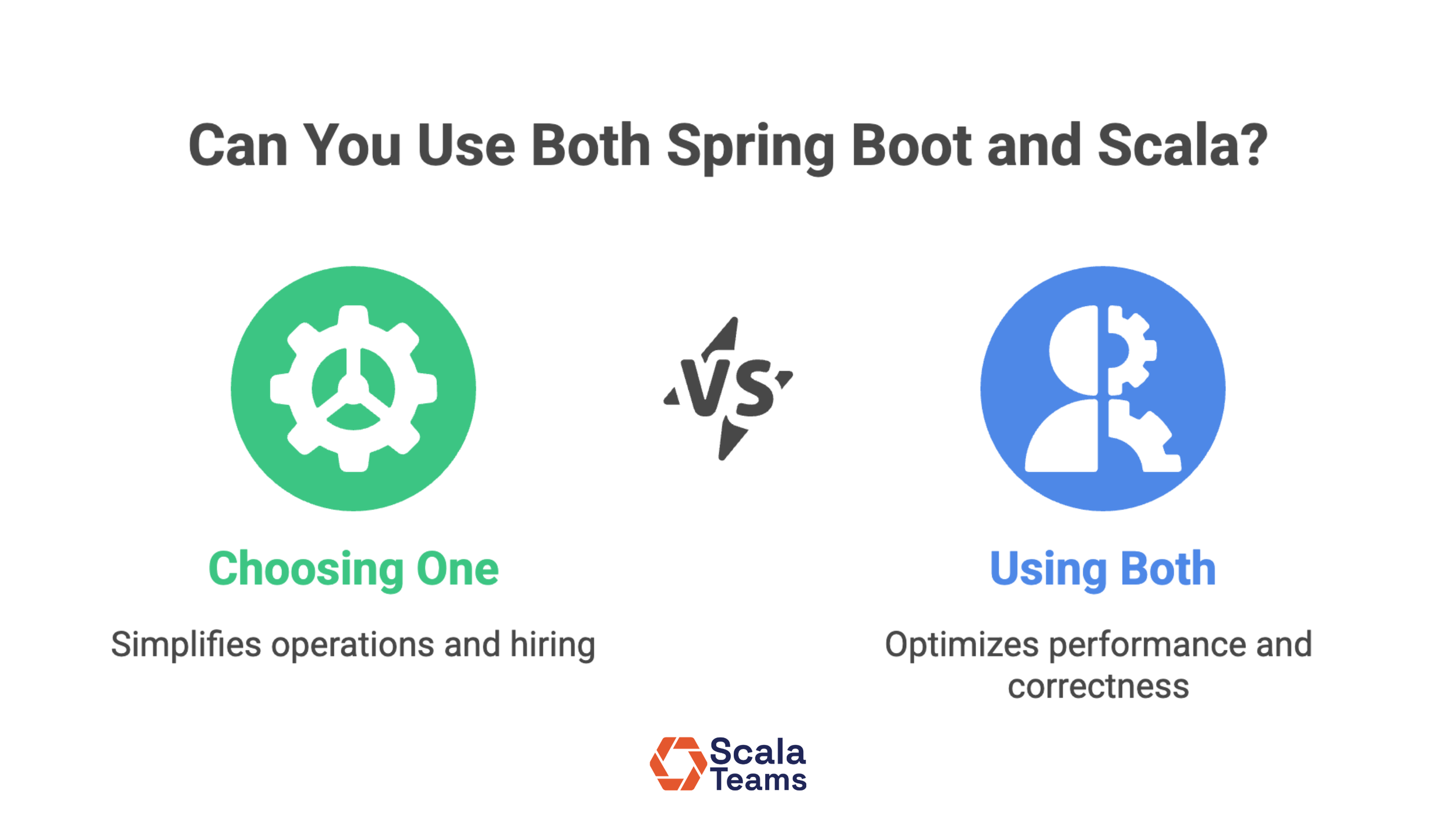
Can You Use Both Spring Boot and Scala?
Yes, and many mature engineering teams do. The pattern is predictable: Spring Boot for REST APIs, backend services, and integration-heavy microservices. Scala for data pipelines, Spark jobs, and high-concurrency or high-correctness systems. Netflix, LinkedIn, and a significant portion of financial services firms run this split architecture successfully.
Running both stacks adds operational overhead: separate toolchains, different hiring profiles, and knowledge that doesn't transfer as cleanly between teams. But it also means you're using each tool where it's actually strong instead of forcing one to cover ground it wasn't designed for. For organizations past a certain scale, that tradeoff is usually worth it.
The Real Question Is About Your Next 18 Months
Spring Boot and Scala both solve real problems well. The choice comes down to what your team is building, how quickly you need to move, and what kind of technical investment you're prepared to make.
If your roadmap is microservices, APIs, and integration work with a Java-experienced team, Spring Boot is the lower-risk, faster-moving option. If you're heading into data infrastructure, high-concurrency systems, or complex-domain software where compile-time correctness pays dividends, Scala is the sharper tool.
The question isn't which language or framework is better. It's which one puts your team in the best position to ship well, maintain confidently, and scale without constant rework. That answer looks different for every organization.
If Scala is on your roadmap and you need experienced engineers who can hit the ground running, that's exactly what we do. Scala Teams provides dedicated Scala developers and teams for companies that need the language's strengths without the long hiring cycle. Talk to us about your Scala needs.
