
Scala 3.8.2 Is Out- The Latest Version Changes for Your Engineering Team
Scala 3.8.2 was released on February 24, 2026; it’s the latest in a release cycle that's been building toward something significant. To understand what 3.8.2 adds, it helps to know what 3.8 changed back in January, because the two together tell a story: a language maturing fast, with a clear runway to its next long-term support version.
Here's what changed, why it matters, and what engineering teams should be thinking about.
What Was New in Scala 3.8 (Released in January)
Scala Now Compiles Itself
For years, Scala's standard library was compiled using Scala 2.13. It worked fine, Scala 3 consumed it through binary compatibility, but it was a bit like a car manufacturer that builds their own engines, except the flagship model still ships with an engine from the previous generation.
That's over now. In Scala 3.8, the standard library is compiled with Scala 3 itself. It's mostly invisible to developers migrating existing code (the change is binary compatible), but it signals something important: Scala 3 has fully outgrown its predecessor. More practically, it opens the door for Scala to develop a standard library, one designed entirely for the modern language, starting with Scala 3.10.
This matters for teams making long-term bets on the language. It's the kind of architectural milestone that reduces future technical debt and makes the ecosystem more self-sufficient.
JDK 17 Is Now Required
This is the practical item that teams need to act on. Scala 3.8 requires JDK 17 or later, both to compile and to run.
The reason is forward-looking: JDK 26 will break access to sun.misc.Unsafe, a low-level Java API that Scala's older lazy value implementation relied on. The Scala team made the call to modernize now rather than scramble later.
If your project is already on JDK 17+, you're fine. If not, you'll need to upgrade before migrating to Scala 3.8. Teams that need to stay on older JVMs still have an option: Scala 3.3 LTS continues to produce JDK 8-compatible bytecode and will be supported for the foreseeable future.
JDK 17 has been the industry standard for years, and this is a good forcing function to close that gap if you haven't already.
Developer Experience: The Improvements That Actually Save Time
Beyond the architectural changes, 3.8 brings a set of quality-of-life improvements that compound over time into meaningful productivity gains.
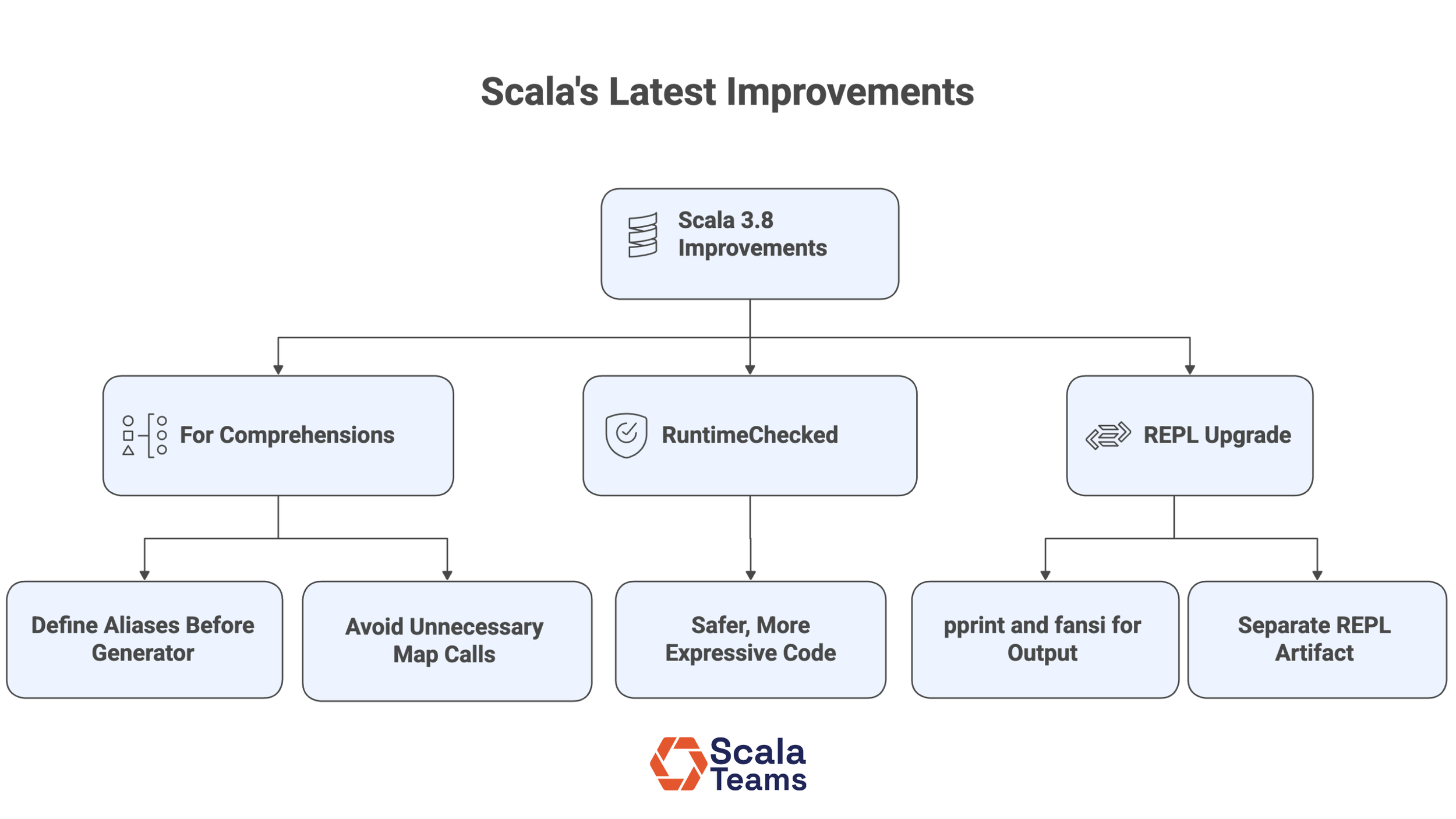
For comprehensions got better. Scala's for expressions are heavily used for working with collections, asynchronous code, and data pipelines. The improved desugaring, first previewed in 3.7 and now stable, removes some long-standing awkward behaviors and generates more efficient bytecode. Two things specifically: you can now define aliases before your first generator, and the compiler avoids unnecessary intermediate map calls when they're not needed. This results in less boilerplate and slightly faster code.
runtimeChecked replaces @unchecked. This is a small change with a big ergonomic payoff. When Scala's compiler warns you about potentially unsafe pattern matches, you previously had to suppress it with an awkward annotation syntax. The new runtimeChecked method is clean, readable, and chainable. This means developers write safer, more expressive code without fighting the type system.
The REPL got an upgrade. Scala's interactive shell now uses pprint and fansi for output rendering, which means cleaner, formatted results instead of walls of hard-to-read text. The REPL also becomes a separate artifact in 3.8, which is a breaking change for tools that embed it. Now, the REPL is easier to integrate and extend going forward.
Experimental Features Worth Watching
Scala 3.8 introduces several experimental features that aren't production-ready but signal where the language is headed. These matter for engineering teams evaluating Scala's trajectory.
SIP-70: Flexible Varargs- Spread Multiple Collections in a Single Call
Flexible varargs (SIP-70) lets you spread multiple collections into a varargs function call without manual concatenation, eliminating a recurring friction point in functional-style data processing code.
SIP-67: Strict Equality Pattern Matching for Enums and Case Objects
Strict equality pattern matching (SIP-67) addresses a long-standing tension between Scala's strict equality mode, which prevents nonsensical comparisons, and practical pattern matching over enums and case objects. This will make strict equality more adoptable in real codebases. A step toward safer, more predictable code by default.
Laying the Groundwork for Null-Safe, Side-Effect-Aware Code
Capture checking and explicit nulls are the longer-horizon experiments. Capture checking tracks how functions capture external state, enabling stronger guarantees about side effects. Explicit nulls make null a first-class concern in the type system, similar to Kotlin's approach. Neither is ready for production, but both are signs of a language that's taking correctness seriously at a deeper level.
What's New in Scala 3.8.2
The headliner in 3.8.2 is a new compiler warning that catches a real migration risk introduced by 3.8's betterFors desugaring.
Scala 3.8 changed how for comprehensions handle consecutive val bindings, removing an intermediate map step that was previously inserted. That sounds like an optimization, and it is, but it also means that code involving collections like Map can now produce a different result type at runtime depending on which version of Scala compiled it.
The new warning in 3.8.2 flags this pattern so teams migrating from 3.7 know where to look. If you need the old behavior, you can either explicitly convert your Map to Iterable first, or compile with -source:3.7.
For teams upgrading, this warning is your safety net. Don't ignore it.
:dep Support in the Scala REPL
The REPL can now load external library dependencies with :dep. Previously a Scala CLI-only feature, this brings a capability that developers in other ecosystems have long taken for granted directly into Scala's interactive shell. It's a small addition with an outsized impact on the day-to-day experience of exploring libraries and prototyping ideas.
Scala.js 1.20.2 and Scala CLI 1.12.2
Both the Scala.js runtime and Scala CLI received version bumps. For teams doing full-stack Scala or using Scala CLI as a scripting and build tool, these bring bug fixes and incremental improvements. The CLI update also introduces new aliases for release candidate and nightly Scala versions, making it easier to test against upcoming releases.
Scala 3.9 LTS is Next
Scala’s latest update marks a feature freeze. Therefore, Scala 3.9 will have no new language features, only bug fixes and stabilization. That means 3.8 and 3.9 LTS will be functionally identical in terms of features. Code written for 3.8 should require no changes to run on 3.9 LTS.
For teams planning migration timelines, this is useful information: if you use 3.8 today, you're essentially adopting the feature set of the next LTS.
The Bigger Picture
Every few releases, a programming language has a moment where the work of years starts to show. Scala 3.8 is one of those moments: the standard library overhaul, the JDK modernization, the REPL improvements, and the stabilization of long-awaited features. Taken together, they reflect a language that has done the hard infrastructure work and is now in a position to build on it.
For businesses running Scala in production, this is validation. And for teams evaluating Scala, the ecosystem is more mature and stable than it's been at any point in the language's history.
Interested in what this might mean for your specific stack? Fill out the form below to talk through your migration options or development needs.
To explore the latest Scala update yourself, visit GitHub.
