
Why Engineering Leaders Are Still Choosing Scala in 2026
When you're making a backend language decision, you're not really making a technical choice. You're making a risk-management decision that will affect system reliability, team velocity, hiring costs, and maintenance overhead for years to come.
Scala isn't the most popular language. It's not the easiest to hire for. But for companies running complex, high-stakes backend systems, it consistently delivers something more valuable than popularity: predictability.
This article breaks down why Scala remains a serious backend choice in 2026 and how to evaluate whether it's right for your systems. Key points include:
- Scala's compiler catches errors before deployment, reducing production incidents and the operational cost of failures
- It was built for concurrency and scale, making it a natural fit for high-throughput systems, data pipelines, and event-driven architectures
- The ecosystem is mature and stable, consolidating around well-maintained tools rather than chasing novelty
For companies where downtime is expensive and failures have consequences beyond a support ticket, Scala is a practical choice.
What Are the Benefits of Using Scala?
The most compelling argument for Scala isn't technical; it's operational. Scala's compiler (the tool that converts code into running software) catches a wide class of errors before anything is deployed. That means bugs get flagged during development, not during a Saturday outage.
This translates directly to:
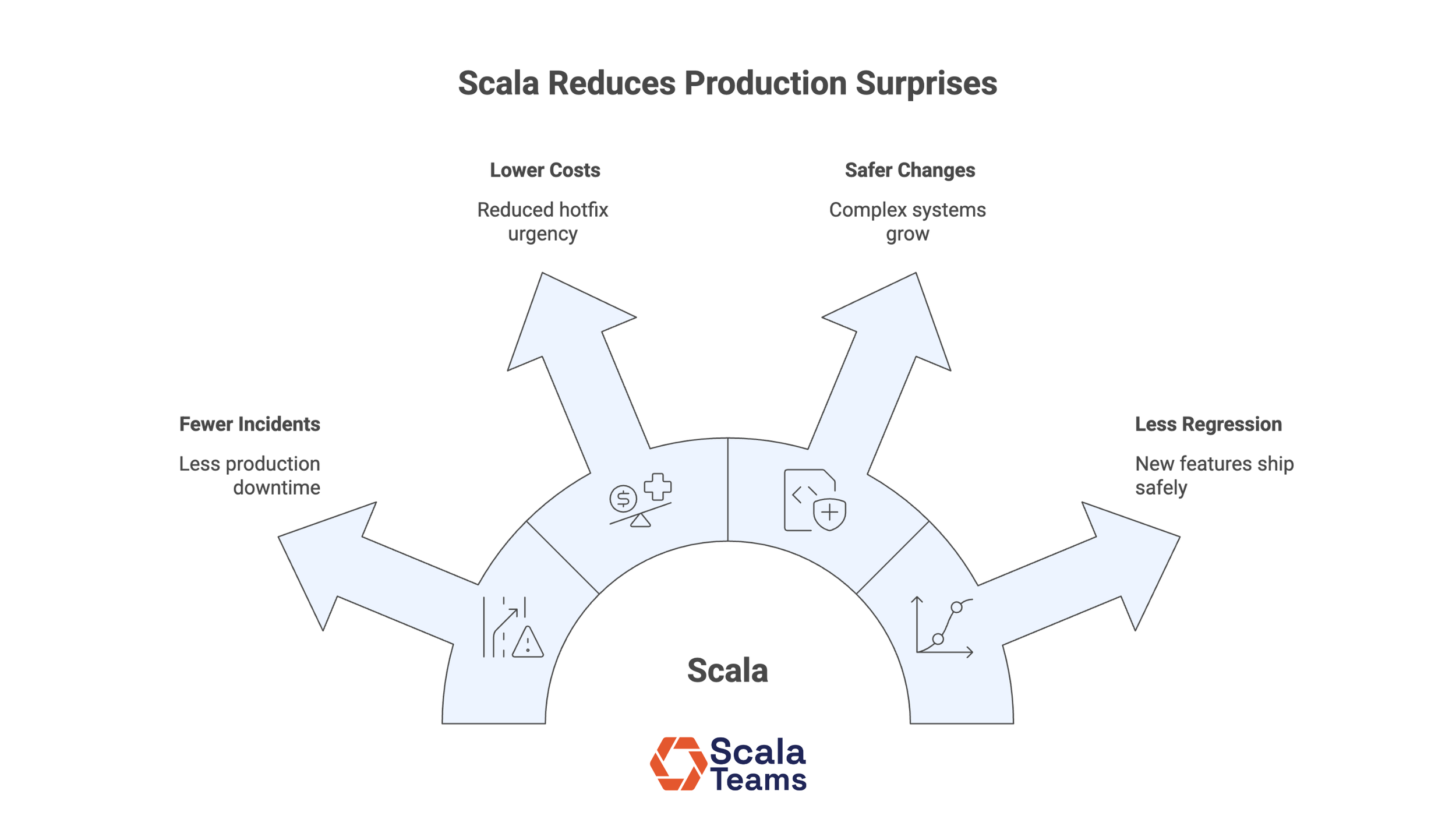
Fewer production incidents
Lower cost and urgency around hotfixes
Safer code changes as systems grow more complex
Less regression risk when shipping new features
Companies in finance, ecommerce, data infrastructure, and regulated industries have the most to gain because a production failure doesn't just wake up the engineering team. It can trigger compliance reviews, customer refunds, and headlines.
What "Functional Programming" Actually Means for Your Systems
You'll hear Scala described as a functional programming language. What this means in practice is that Scala allows engineers to write code where data doesn't change unexpectedly, failures are handled explicitly, and the logic behind complex business processes is easier to trace and test.
The result is:
More predictable systems: code behaves consistently, even under edge-case conditions
Fewer mysterious bugs: data flows are explicit rather than hidden
Better testability: engineers can verify behavior in isolation before it goes to production
Easier onboarding: structured, readable code is faster to understand than ad hoc implementations
For distributed systems, data pipelines, and event-driven architectures, this approach leads to more stable services under load.
Built for Scale, Not Retrofitted for It
A lot of languages handle concurrency as an add-on, something bolted on after the fact as systems grow. Scala was designed from the ground up to handle parallel workloads: simultaneous requests, background processing, real-time data streams, third-party integrations, all running at once.
Architectural decisions matter when:
Your platform needs to process high transaction volumes without degrading
You're running microservices that need to communicate reliably at scale
You're building or maintaining data pipelines where throughput and accuracy both matter
Downtime is expensive
Scala's performance profile is why it became the language of choice for companies building large-scale data infrastructure.
Is Scala's Ecosystem Right for Enterprise Use?
In enterprise software, a stable, boring ecosystem is a feature, not a criticism. Scala's ecosystem has consolidated around well-maintained tools and libraries. This means you're not dealing with a chaotic open-source landscape where critical dependencies go unmaintained six months after your team adopts them.
Using Scala gives you:
Established build tools and testing frameworks
Strong interoperability with the broader Java ecosystem (decades of tested libraries)
Modern library support for Scala 3, the current major version
Enterprise-grade tooling inherited from the JVM
If your organization has existing Java infrastructure, Scala can integrate without forcing a platform migration. It's a path to modernization, not a rip-and-replace.
Which Industries Use Scala?
Scala isn't dominant in general web development, but it doesn't need to be. Its adoption follows a "narrow but deep" pattern: concentrated in industries and use cases where correctness and performance aren't negotiable.
Financial services: trading systems, risk modeling, transaction processing
Data engineering: large-scale batch and streaming data pipelines
Media and streaming platforms: high-throughput content delivery infrastructure
High-reliability backend services: anywhere system failure carries significant consequences
Companies operating in these industries don't pick Scala because it's trendy. They choose it because they've evaluated what happens when systems fail and decided the upfront investment is worth it.
Read More: Using Scala for Data Science
The Tradeoffs of Choosing Scala
No language evaluation is complete without the downsides.
Hiring is Harder
The Scala talent pool is smaller than Java, Python, or Go. That said, experienced backend engineers can ramp up with structured onboarding, and those who do specialize in Scala are usually senior-level and highly capable. Working with an outsourced Scala team sidesteps this challenge entirely, but it's worth factoring into your model either way.
Read More: Offshore Software Development: Strategy & Models
Expect to Defend the Choice
Since Scala isn't a mainstream default, internal champions sometimes have to justify the choice more explicitly. If you're in that position, the business case centers on reduced incident costs and long-term maintenance savings, not language preference.
Migration Learning Curve
Moving to Scala 3 requires some tooling adjustments. Teams with experienced Scala engineers navigate this without major disruption; teams without this expertise can run into friction.
These are solvable operational challenges, not capability gaps.
How Scala Reduces Long-Term Maintenance Costs
Here's the strategic framing that often gets skipped in language evaluations: the most important cost isn't the initial build, it's the ongoing maintenance.
As codebases grow over multi-year product roadmaps, languages that enforce structure pay dividends. Scala's design makes large-scale refactoring safer, reduces the accumulation of technical debt, and makes complex business logic easier to model accurately in code. That matters when your platform in year four is three times more complex than it was at launch.
How to Staff a Scala Project
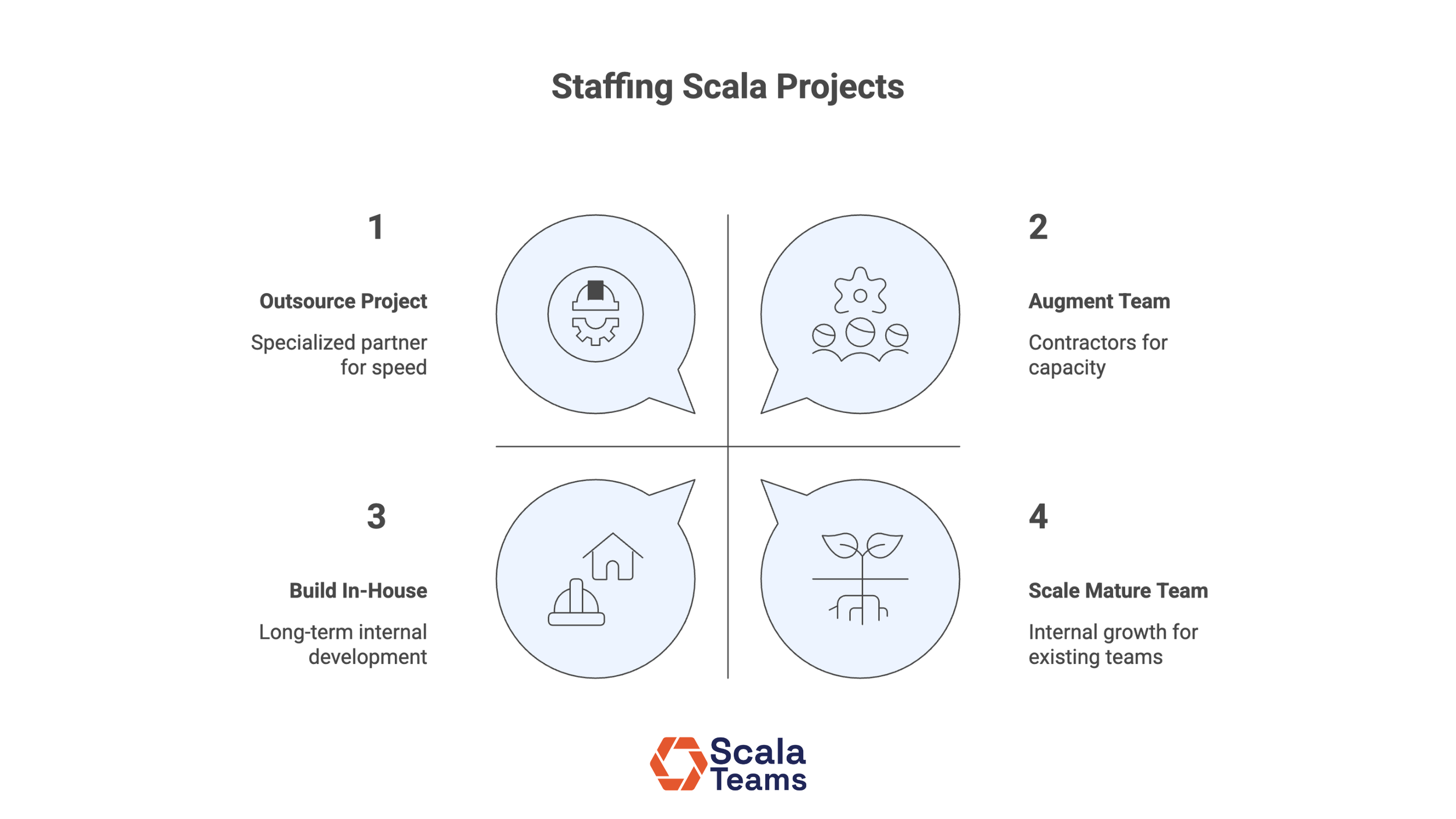
Hiring Scala engineers in-house is doable, but it takes time. The talent pool is smaller than it is for mainstream languages, which means longer recruiting cycles, more competition for the same candidates, and higher compensation expectations. For companies that already have a Scala footprint and are scaling a mature team, it can make sense. For everyone else, it's often the slowest and most expensive path to getting something built.
Staff augmentation, bringing in contractors to work alongside your internal team, is a middle-ground option that works well when you have existing Scala expertise in-house and need to add capacity without permanent headcount. Without that internal foundation, though, you're still dependent on your team to provide direction and context, which limits the impact contractors have.
Outsourcing to a specialized Scala development partner tends to be the most practical option for companies that want to move quickly without the overhead of building internal expertise from scratch. You get access to engineers who already know the ecosystem, have worked through the common pitfalls, and operate with real autonomy. The key is finding a partner with genuine Scala depth, not a generalist team that lists it on their capabilities page. When that fit is right, it significantly improves timelines and lets your internal team focus on the work only they can do.
Is Scala the Right Choice for Your Systems in 2026?
Scala is a strong fit if your team is operating under these conditions:
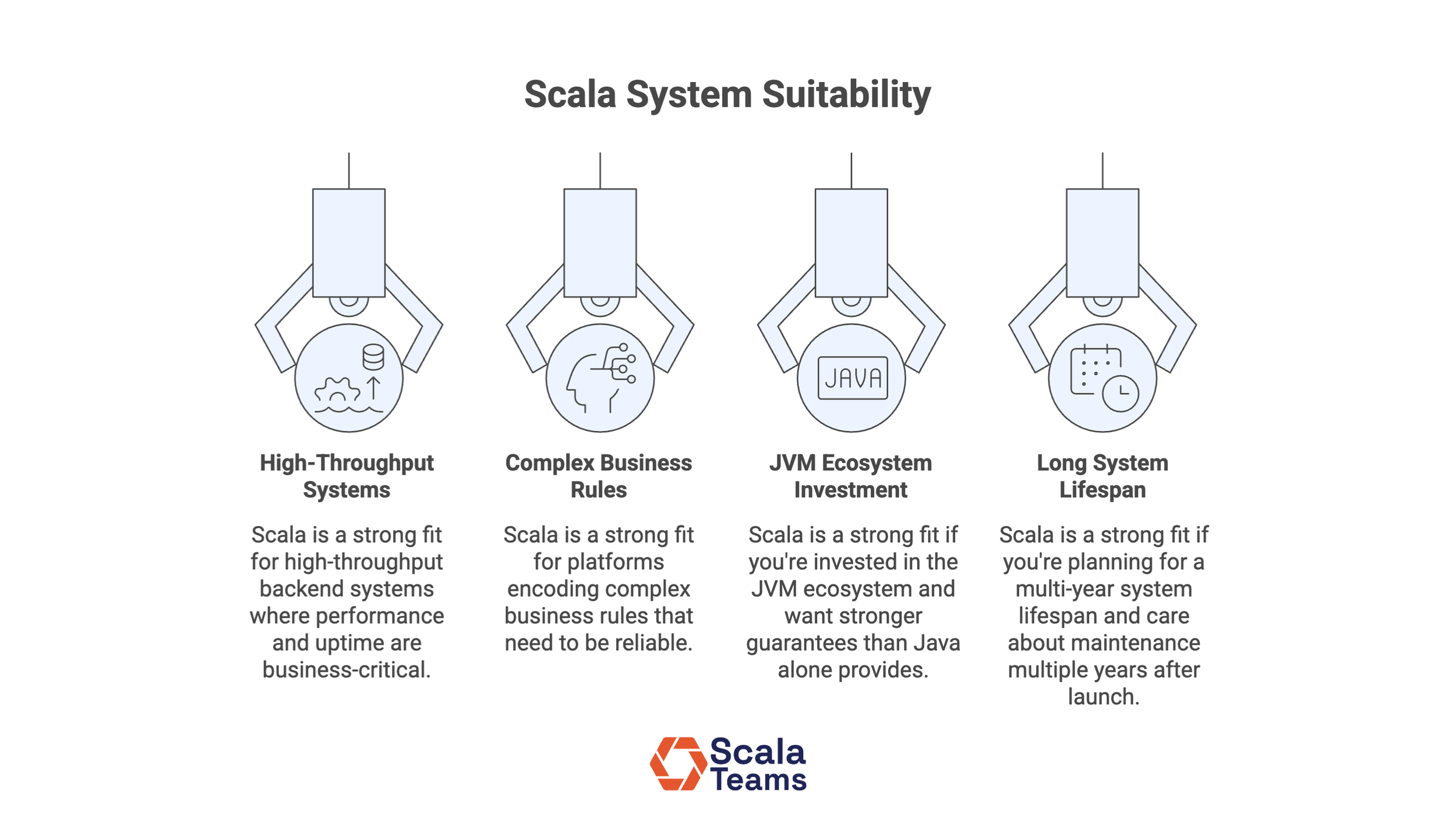
You're running high-throughput backend systems where performance and uptime are business-critical
Your platform encodes complex business rules that need to be reliable
You're invested in the JVM ecosystem and want stronger guarantees than Java alone provides
You're planning for a multi-year system lifespan and care about what maintenance looks like multiple years after launch
Scala isn't the right call for every situation. Small internal tools, short-lived prototypes, and straightforward applications don't need this level of rigor. Adding it would create overhead without a long-term payoff. Scala is the right choice for systems where the stakes are high and the long game matters.
Companies that regret their backend language choices rarely made them carelessly; they just optimized for the wrong thing. Speed to hire, familiarity, and what everyone else was using. Scala asks you to optimize for something different: what does this system need to look like in three years, under pressure, and when the stakes are higher than they are today? That's a harder question, but it's the right one.
Looking for Scala development expertise without the hiring headache? Book a quick intro call with Scala Teams to see how our senior Scala developers can integrate with your team and start delivering from day one.
