
The Real Benefits of Offshore Software Development
Offshore development has a reputation. You've probably inherited it from someone on your team who worked somewhere that tried it badly… a vendor who disappeared into a ticket queue, code that technically ran but that nobody wanted to maintain, standups at 11pm. That story is real. It's also not the whole story.
The companies that write off offshore development entirely are solving the wrong problem. They didn't have an offshore problem. They had a collaboration problem, and that's fixable.
This article explains why offshore development succeeds for some companies and fails for others. Key points include:
- Offshore development fails when treated as a ticket-execution vendor and succeeds when treated as a team extension
- The global Scala talent pool is far larger than the local U.S. market, especially for distributed systems and data-intensive platforms
- Cost efficiency comes from reduced hiring risk, faster onboarding, and the ability to scale capacity without long-term headcount drag
- Offshore engineers can accelerate delivery by owning migrations, refactors, and infrastructure work that frees internal teams to focus on core product initiatives
- Long-term partnerships, strong onboarding, and proactive communication separate strategic partners from transactional vendors
When integrated into planning and given real ownership, offshore teams expand engineering capacity, reduce hiring constraints, and support sustained product growth.
Why Offshore Development Gets a Bad Rap
Most companies that've had a bad offshore experience share a version of the same story: they hired a team to execute a spec, treated them like a black box, and were surprised when the output didn't match what they had in mind.
That's not an offshore problem. That's a collaboration problem.
The companies that consistently get value from offshore development treat it differently. They share context and bring offshore engineers into planning conversations, instead of sharing tickets and sprints. Successful companies measure outcomes, not hours.
That mindset change is what separates offshore development as a cost-cutting tactic from being a genuine growth lever.
The Scala Talent Problem Is Real, and Offshore Solves It
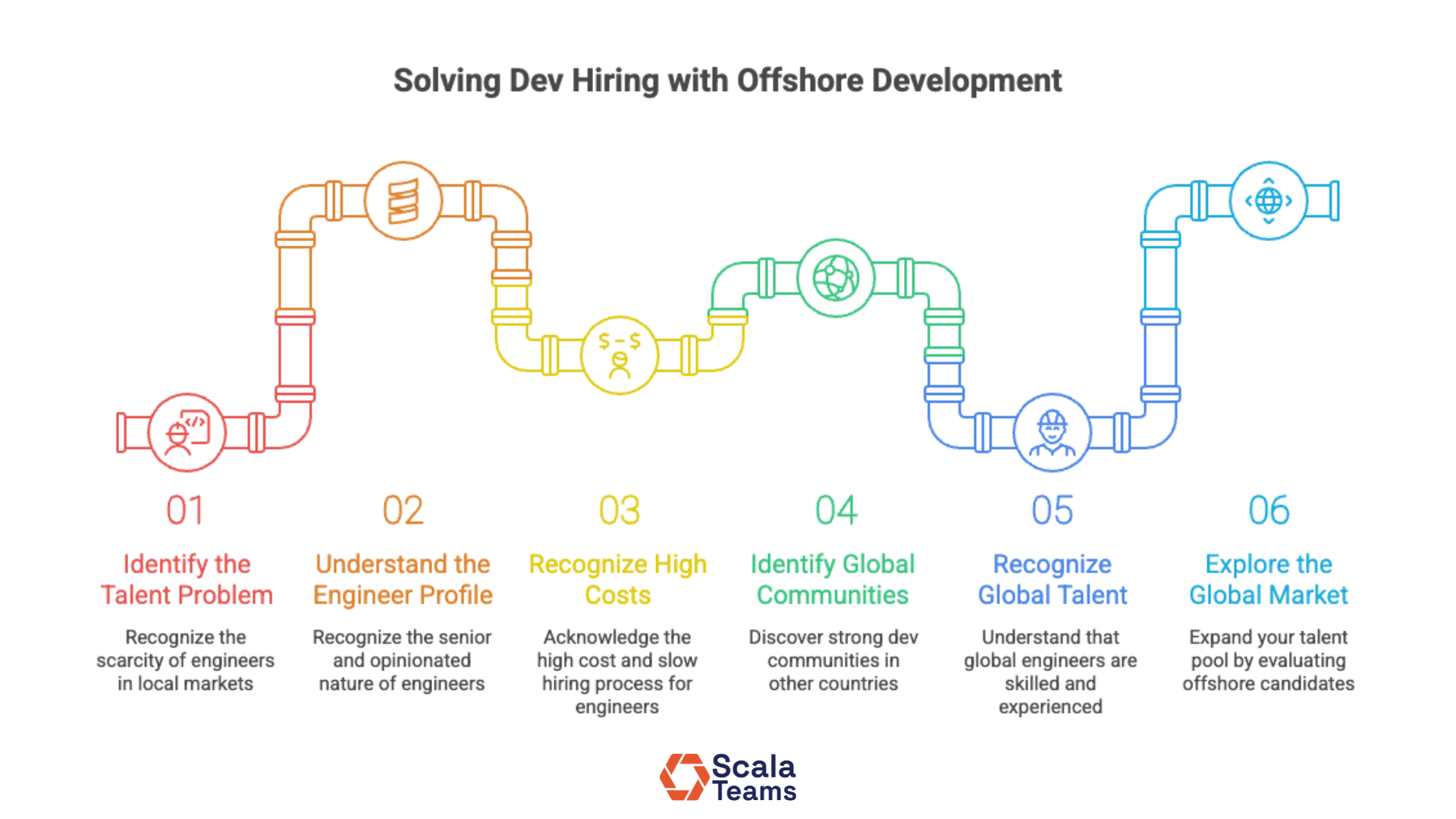
If you're building on Scala, you already know the local hiring market can be brutal. Scala engineers are rare because the language attracts a specific profile: senior, opinionated developers who chose it deliberately, usually for its type safety, functional programming model, or performance at scale. They don't come cheap, they don't come fast, and they likely aren't going to be your third hire at a seed-stage startup.
The global picture is different. Strong Scala communities exist in Eastern Europe, Latin America, and parts of Asia, the regions that produced engineers working on Apache Spark, Akka, and distributed systems at companies like Twitter, LinkedIn, and Databricks. These aren't "good for offshore" engineers. They're engineers who just happen to be located somewhere other than San Francisco or New York.
When US companies limit their Scala search to local candidates, they're fishing in a very small pond. Offshore development opens the actual market.
What "Cost Efficiency" Actually Means
The cost conversation around offshore development tends to flatten into "it's cheaper," which undersells what's actually happening.
Yes, competitive rates are part of it. But the more important financial dynamic is how offshore development affects your hiring risk.
Onboarding a full-time Scala engineer in the US is a 6–12 month process from job posting to productive contribution, if the hire works out. If it doesn't, you've spent that time and money, and you're back at the start. Offshore teams with established onboarding processes and existing Scala bench strength dramatically shorten that timeline so you can scale up or down without the organizational drag of headcount decisions.
For companies with product roadmaps that aren't perfectly predictable (which is most of them), that flexibility has real dollar value that doesn't show up in hourly rate comparisons.
Accelerating Delivery Without Burning Your Internal Team
The most common use case we see: an internal engineering team that's good but stretched thin, sitting on a backlog that keeps growing no matter how fast they move.
Offshore Scala engineers solve this in two ways. First, the obvious one: more capacity. Second, the less obvious one: they take on the work your internal team doesn't want to do, the migration, the refactor, the legacy service that needs to be stabilized before you can build on top of it, freeing your core team to focus on the product work that actually matters to them.
When offshore engineers are integrated into your planning and have visibility into why something is on the roadmap, that division of labor works cleanly. When they're handed tickets with no context, you get technically correct work that misses the point.
The Specialization Advantage
Scala's primary use cases, like distributed data processing, high-throughput financial systems, and real-time analytics infrastructure, require engineers who've worked in those environments before. The debugging intuition, performance-tuning instincts, and familiarity with the Akka ecosystem or Spark internals comes from experience, not just knowing the language.
An offshore team that specializes in Scala brings that pattern recognition to your project from day one. This means you're not paying for someone to learn on the job; you're paying for judgment that already exists.
What Long-Term Development Partnerships Look Like
Short-term offshore engagements exist, but they're rarely where the value compounds. The companies getting the most from offshore Scala development are the ones that brought in teams for a specific project, watched how it went, and then restructured for ongoing engagements.
That looks like: offshore engineers embedded in roadmap conversations, with defined ownership over specific services or infrastructure layers, operating with the same context as your internal team, not as a vendor relationship, but as a distributed team.
Choosing an Offshore Partner, Not a Vendor
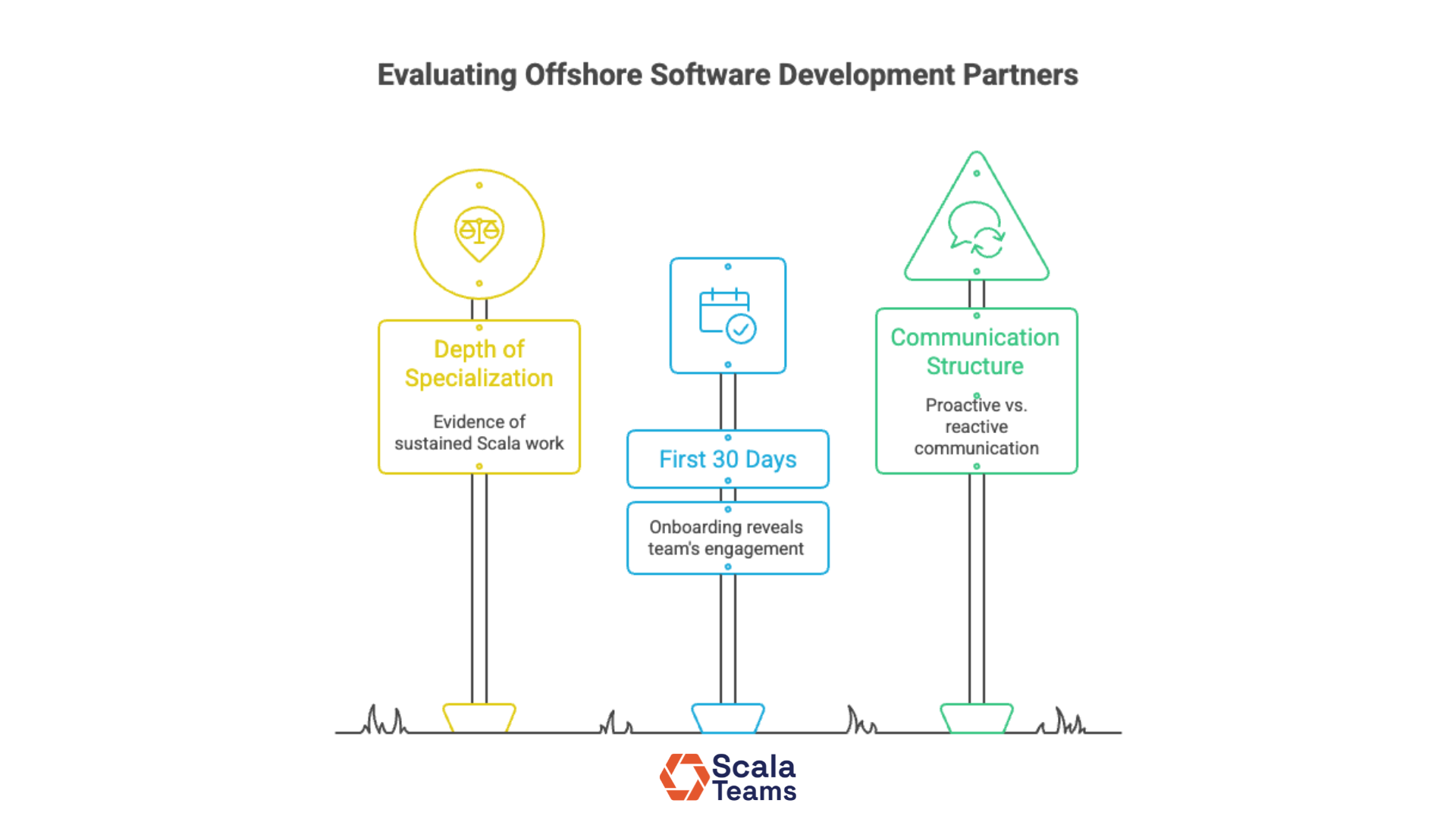
The practical difference between a good offshore partner and a bad one usually comes down to three things:
Depth of Specialization
Not "we have Scala developers" but evidence of sustained Scala work: the kinds of systems they've built, the scale they've operated at, the contributions their engineers have made to the ecosystem.
How They Handle the First 30 Days
Onboarding reveals everything. A team that asks good questions, surfaces assumptions, and engages with your architecture as if they're going to own it long-term is different than a team waiting to be told what to build.
Communication Structure
Timezone overlap, escalation paths, and how they handle blockers are mechanics that matter, but the underlying thing you're evaluating is whether this team communicates proactively or reactively. Reactive communication is the root cause of most offshore horror stories.
The Bottom Line
Offshore software development works when it's treated like what it actually is: a team extension, not a cost line item. For Scala specifically, where the global talent pool dramatically outpaces what's available domestically, it's often not just a good option, it's the only realistic path to building and maintaining the engineering capacity you need.
The question isn't whether offshore development works. It's whether you're set up to make it work. Partner with Scala Teams to build dedicated offshore teams aligned with your goals.
