
How to Hire Scala Developers Fast Without a Months-Long Search
The job posting goes up on a Tuesday. By the end of the week, you have a dozen resumes. Maybe two of them have used Scala in a production context. A month later, you've completed a handful of technical screens, and the one candidate who actually impressed you has declined to move forward because another offer came in faster. The role resets, the roadmap slips, and the backlog grows.
It's the reality of hiring in a niche technical market. Scala engineers are rare, not because the language is obscure, but because the engineers who choose it tend to be opinionated, senior, and employed. They don't flood job boards, and local hiring markets can rarely surface enough of them to meet the demand.
There's a faster path to the Scala talent your team needs, one that doesn't involve waiting out a search that may take months and still come up short. This post covers what that looks like: how flexible Scala experts integrate into existing teams, how vetted outsourcing partners change the supply equation, and what to look for when choosing one.
Hiring senior Scala developers through traditional recruiting is slow, competitive, and often fails entirely. The Scala talent market is small and senior-skewed by design. Faster options exist:
- Flexible Scala experts integrate directly into your team and contribute without a long ramp period
- Vetted outsourcing partners give you access to pre-screened senior engineers at the moment you need them
- Outsourcing eliminates recruiting, vetting, and onboarding overhead without sacrificing code quality
- The right partner maintains quality and lets you scale capacity up or down as the roadmap changes
Why the Scala Hiring Market Is Structurally Different
Most engineering roles are hard to fill because of competition. However, Scala roles are hard to fill because the pool is inherently small. Scala attracts a specific profile: senior engineers who deliberately choose the language, usually for its strong type system, functional programming model, or performance in distributed systems at scale. They aren't generalists who picked it up on the job. They made a technical bet, and most of them made it years ago.
That means the supply is senior-weighted and relatively small in any given local market. Companies building with Scala are often competing for the same handful of qualified candidates within their geography. Strong Scala communities exist in Eastern Europe, Latin America, and parts of Asia, producing engineers who built on Apache Spark, Akka, and distributed infrastructure at companies like X (formerly Twitter), LinkedIn, and Databricks.
Limiting your search to local candidates means fishing in a very small pond. The talent market for Scala isn't thin globally; it's thin locally. The global talent points directly to the solution. There are enough senior Scala engineers in the world. There aren't enough in your city, and recruiting cycles aren't designed to cross that gap quickly.
The Real Cost of a Slow Search
The visible cost of a delayed hire is the salary you're not paying yet. The invisible cost is everything else: the features that don't ship, the technical debt that accumulates while an under-resourced team takes shortcuts, and the engineers already on your team who burn out trying to cover a gap that shouldn't exist.
A three-to-six-month hiring cycle is more than a recruiting inconvenience. Every sprint that passes without the capacity to execute your roadmap is a sprint where your competitors move faster, customers wait longer, and the strategic value of whatever you're building erodes.
For teams using Scala in high-stakes contexts (data pipelines, financial systems, real-time processing infrastructure), that delay has measurable downstream consequences.
Option 1: Flexible Scala Experts Who Integrate Without the Friction
The fastest path to additional Scala capacity isn't a new full-time hire. It's a senior engineer who's already done this before. They’re someone who has joined active codebases mid-stream, understood existing architecture quickly, and started contributing before the average candidate has completed their second round of interviews.
Flexible Scala experts work differently from generalist contractors. Because Scala requires a specific depth of understanding around effect systems, type-level programming, and functional patterns, a developer who looks senior on paper may still require months of ramp time to produce production-safe code in an unfamiliar codebase. Senior Scala engineers from specialized outsourcing networks have seen enough variation in production Scala to short-circuit that process significantly.
What integration actually looks like
In practice, a well-matched Scala expert joining an existing team can:
Take ownership of a specific module, service, or high-priority feature within the first week
Operate inside your existing tooling without a learning curve on the process
Contribute to architecture discussions, not just ticket execution, if that's what the work requires
Unblock your internal team from overflow, refactors, or the legacy services that nobody wants to touch
This last point matters more than it sounds. When your core team is blocked on a migration or stabilization task they'd rather not do, every sprint that work drags on costs you their attention on the product work that actually energizes them. Flexible outsourced engineers absorb that friction so your in-house team stays focused.
Option 2: Vetted Outsourcing Partners Who Solve the Supply Problem
A vetted outsourcing partner doesn't just give you one engineer. It gives you access to a bench of pre-screened Scala talent that can be matched to your specific stack, seniority requirements, and delivery timeline. The recruiting, vetting, and background checks already happened. What remains is matching, and when a partner specializes in Scala, that matching is based on real technical depth, not resume pattern-matching.
The difference between a specialist partner and a generic staffing agency becomes obvious the first time you do a technical review. Generic agencies source anyone who lists Scala on a profile. Specialized partners know the difference between an engineer who understands cats-effect and one who's used it in production under load. That distinction is the difference between a developer who ships clean, maintainable code and one who produces the brittle, macro-heavy systems that give outsourced Scala a bad reputation.
What a good Scala outsourcing partner handles for you
Sourcing and vetting: You don't screen 60 resumes; you meet two or three engineers who are actually qualified.
Onboarding overhead: The partner manages contracts, compliance, and initial alignment so your engineering team focuses on delivery.
Continuity: If an engineer rolls off, the engagement doesn't stop.
Quality accountability: A specialized partner's reputation depends on the code their engineers produce. That accountability is built into the relationship in a way it isn't with a solo contractor.
The practical result is that a months-long internal search gets compressed into days or weeks. The engineers who show up are qualified to contribute immediately. That's what working with a partner like Scala Teams looks like from the inside.
Keeping Your Roadmap on Track Without Overloading Your Team
One of the more underappreciated benefits of outsourced Scala capacity is what it does for the engineers you already have. When a team is stretched, the first casualty is judgment. People take shortcuts they wouldn't otherwise take, defer the refactor that's blocking velocity, and merge the PR that isn't quite right because there's no time to push back.
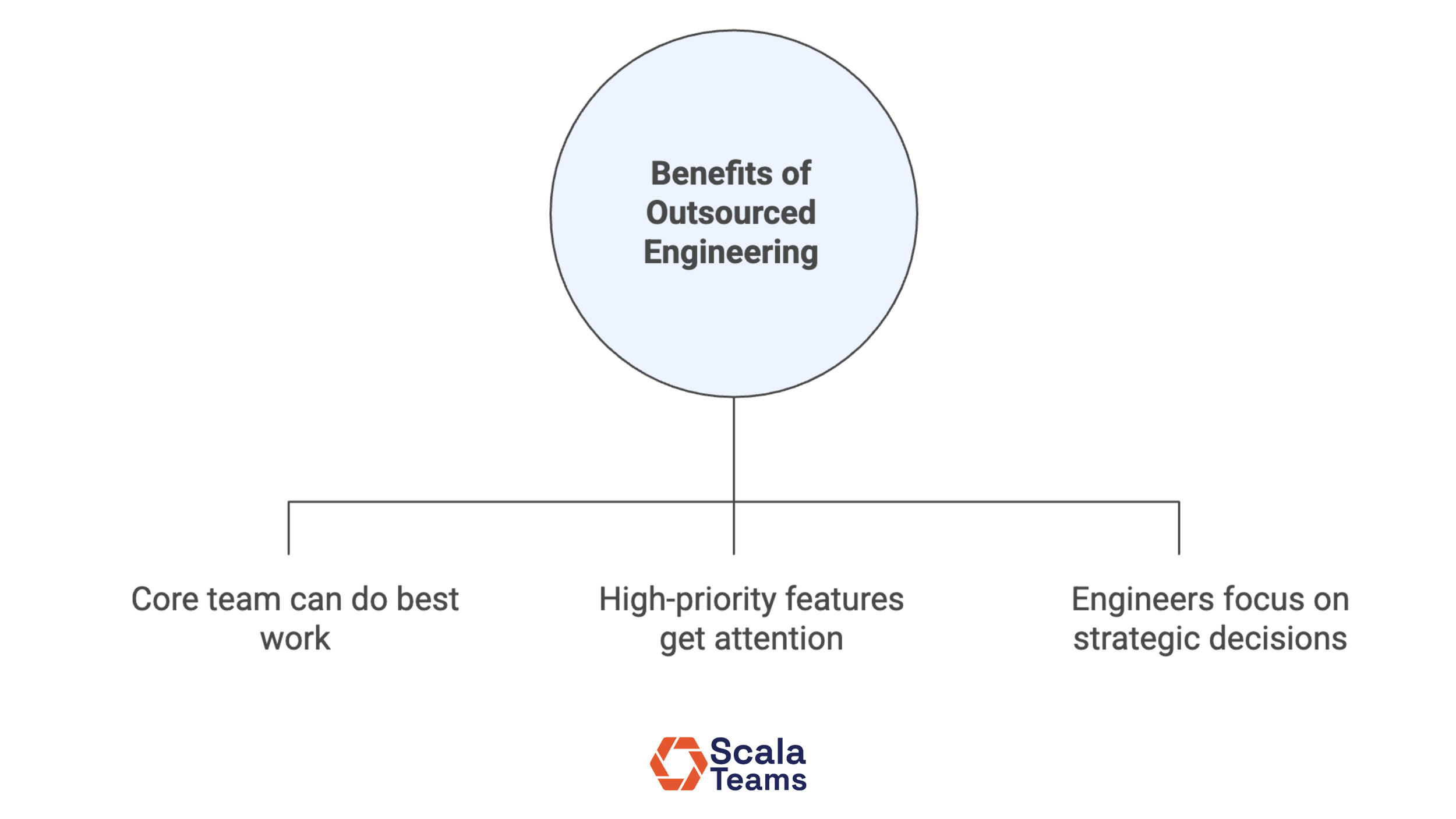
Adding senior outsourced capacity restores the cognitive space for your core team to do their best work. Deadlines get met instead of moved, and high-priority features get the attention they deserve. Your full-time engineers can focus on the architectural decisions and product thinking that only they can do, rather than covering gaps that should have been filled months ago.
For niche stacks like Scala, outsourcing is often the fastest way to access senior engineers while keeping your core team focused.
How to Evaluate an Outsourcing Partner for Scala Work
Not every outsourcing partner is worth working with. A few things to evaluate before you engage:
Depth, not just familiarity
Ask about the engineers' background in functional programming specifically. Scala is a multi-paradigm language, and an engineer who uses it in an object-oriented style misses most of the structural advantages. A partner worth working with can speak to effect systems, type classes, and where their engineers have shipped production Scala.
Codebase integration experience
Ask how their engineers have joined mid-stream projects. The ability to ramp quickly on an unfamiliar codebase is a distinct skill that separates strong engineers from those who only perform well when building from scratch. You want evidence of both.
Engagement model flexibility
A partner that locks you into rigid headcount or long-term commitments without corresponding flexibility is a structural risk. Look for clear terms around scaling, offboarding, and what happens if the work evolves. If you're still weighing engagement models, the comparison between dedicated teams and project-based offshore structures is worth reading before you sign anything.
Communication and async standards
Time zone overlap matters less than people think; communication style matters more. Ask how the team handles async handoffs, how engineering decisions get documented, and what happens when something goes sideways. A partner with clear answers to those questions has worked through them before.
Scaling Scala Capacity Without the Long-Term Commitment Risk
One of the structural advantages of outsourcing over full-time hiring is what happens when the project ends, the roadmap shifts, or the work requires a different skill mix. Full-time headcount is expensive to add and slow to remove. Outsourced teams adjust.
For companies whose engineering needs aren't perfectly predictable (which is nearly all of them), that flexibility has real financial value that doesn't show up in hourly rate comparisons. The loaded cost of a full-time senior Scala hire in the US, including salary, benefits, recruiting fees, onboarding time, and the probability of a mis-hire, is significantly higher than what appears on an offer letter. When that hire doesn't work out, you absorb all of it and start again.
Outsourcing shifts that risk since you pay for delivery, not for headcount. And for a stack as specialized as Scala, that's a meaningful structural advantage.
If you're comparing costs in more detail, the breakdown of offshore software development costs versus full-time hiring covers the financial mechanics behind that trade-off.
Frequently Asked Questions
How long does it take to hire a senior Scala developer?
Hiring a senior Scala developer through traditional recruiting typically takes three to six months from job posting to a productive team member. The Scala talent pool is small and heavily weighted toward senior engineers who are rarely actively job-hunting. Outsourcing partners with an established Scala bench can compress this timeline to days or weeks.
Why is it so hard to find Scala developers?
Scala engineers are a niche subset of the JVM ecosystem. The language attracts developers who choose it deliberately, usually for its type system, functional programming model, or performance in distributed systems. Most experienced Scala engineers are senior, employed, and not actively searching. The effective talent pool in any local market is small, which is why companies increasingly access global Scala talent through outsourcing.
What's the difference between hiring a Scala contractor and using an outsourcing partner?
A solo contractor gives you one engineer on a short-term arrangement. An outsourcing partner provides access to a vetted pool of senior Scala engineers with established onboarding, quality processes, and the ability to scale team size up or down based on your roadmap. Outsourcing partners also handle vetting, compliance, and continuity, so if one engineer rolls off, delivery doesn't stop.
Can an outsourced Scala developer integrate with an existing in-house team?
Yes. Senior Scala engineers from specialized outsourcing partners are experienced working within existing codebases and team workflows. They can take ownership of specific modules, contribute to sprint planning, and operate within your existing tooling from day one. The integration timeline is much shorter than onboarding a new full-time hire.
Is outsourcing Scala development a risk to code quality?
It depends on the partner. Generic staffing agencies rarely have the functional programming depth Scala requires. Partners who specialize in Scala bring engineers who understand type-safe design, effect systems, and production-grade architecture, which is what separates maintainable Scala from the brittle, macro-heavy codebases that give outsourced Scala a bad reputation.
Scala Teams gives you direct access to senior, production-ready Scala developers who integrate with your team and contribute immediately. No months-long search, no mis-hire risk, no bloated recruiting cycle.
Schedule a Call with Scala Teams
