
Scala Development Outsourcing: 7 Tips for Engineering Leaders
Most engineering leaders who've had a bad outsourcing experience can trace it back to a handoff problem. Requirements went in, code came out, and somewhere in between the decisions that actually mattered got made by people who didn't understand the system. With a general-purpose stack, that produces mediocre results. With Scala, it tends to produce something worse: code that's technically valid but architecturally wrong, expensive to untangle, and carrying the wrong opinions baked in at the type level.
Scala development outsourcing done well requires a different operating model from most outsourcing arrangements. The language rewards expertise and punishes ambiguity. Getting the most from an outsourced Scala team means setting up the engagement correctly before the first sprint starts, not discovering what was missing once delivery is underway.
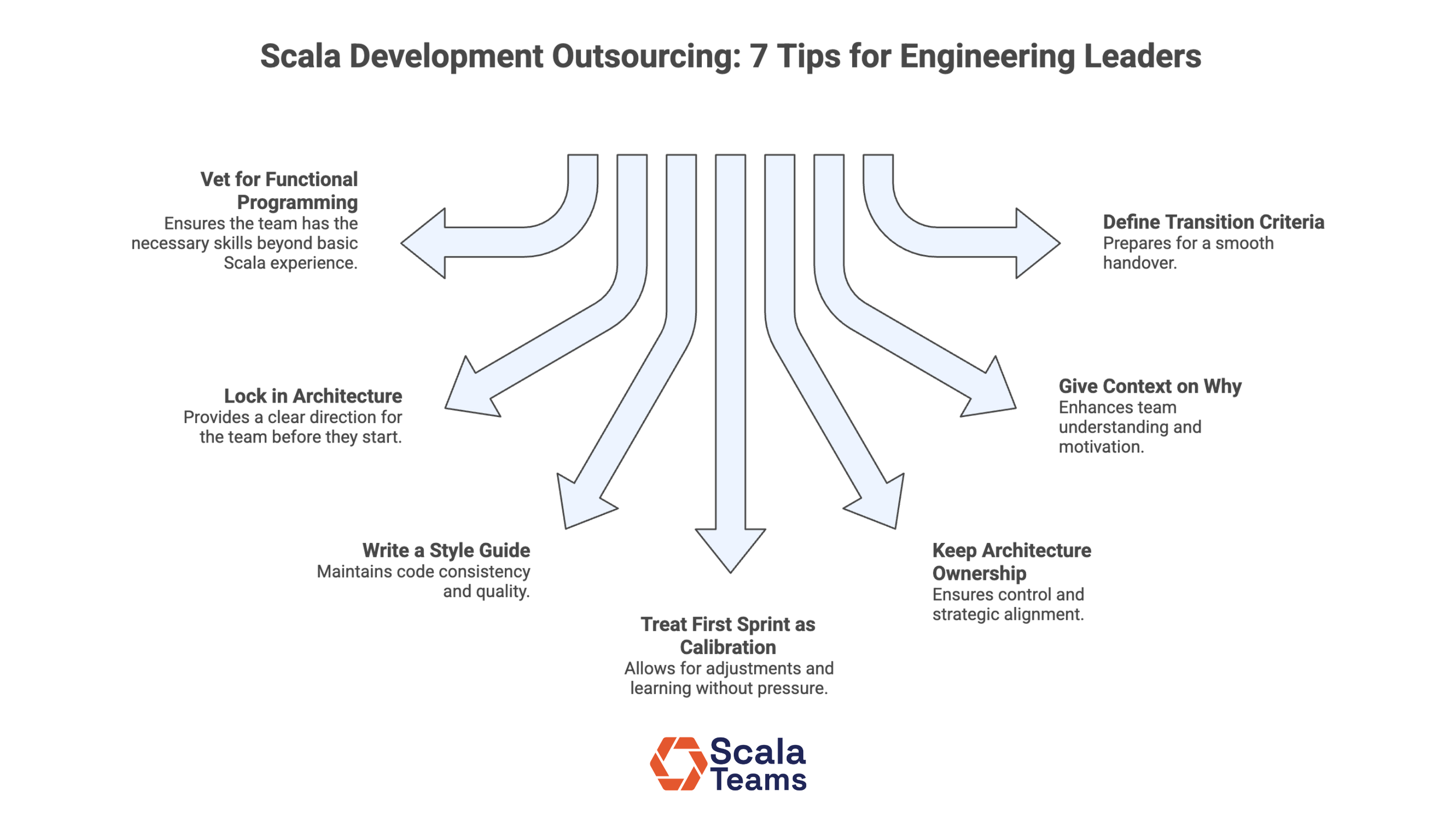
These seven tips are the things experienced engineering leaders do differently when outsourcing Scala development.
- Vet for functional programming depth, not just Scala syntax familiarity
- Establish architecture patterns and a style guide before the team starts
- Use the first sprint to calibrate, not to deliver
- Keep architecture ownership in-house; delegate implementation
- Give outsourced engineers context on why, not just what
- Build async-first communication rituals before day one
- Define your transition and handoff criteria before you need them
1. Vet for Functional Programming Depth Beyond Scala Experience
The Scala job market has a signal-to-noise problem. Many developers have "Scala" on their resume because they used it in a data engineering context, primarily calling Spark APIs with imperative logic written in Scala syntax. That's not the same as an engineer who understands the type class hierarchy, can reason about effect systems, and has opinions on when implicit abuse becomes a maintenance liability.
For serious Scala outsourcing, the interview should probe for functional programming judgment, not just language familiarity. Useful signals:
Can they explain a tradeoff between ZIO and Cats Effect without reciting marketing copy?
When asked about a system they designed, do they talk about the shape of the data or the shape of the objects?
Do they have instincts about when pure FP becomes overcomplicated for the problem at hand?
The best Scala engineers know the language well enough to use less of it when that's the right call. Developers who reach for every advanced feature regardless of context are a code review burden in any setting, but especially in an outsourced one where you can't course-correct in a hallway conversation.
2. Lock in Your Architecture Patterns Before the Team Ramps
Scala's expressiveness is one of its genuine strengths and one of its most common collaboration problems. Two senior Scala engineers can produce dramatically different code that both works, both compiles, and both passes review. The divergence compounds when one of them is on your internal team and the other is offshore, working asynchronously, with limited visibility into how your codebase is actually structured.
Before an outsourced team writes its first line, you should have decided:
Which effect system you're using and why (or why you're avoiding one)
Your approach to error handling: typed errors, exceptions, or a hybrid
How you handle configuration and dependency injection
Your conventions around given / implicit usage scope
What the module and package structure signals about ownership
These aren't things to figure out together during onboarding. If they're unresolved when the team starts, each developer fills the gap with their own prior experience, and refactoring that divergence is significantly more expensive than the conversation you didn't have upfront.
3. Write a Style Guide Before They Write a Line of Code
This is related to architecture patterns but distinct from it. A style guide captures the lower-level conventions that determine whether code is maintainable by the next person who touches it. In Scala specifically, the range of valid styles is wide enough that without explicit standards, you accumulate inconsistency quickly.
A working Scala style guide for an outsourced engagement covers at minimum:
Preferred formatting tool and configuration
When to use for comprehensions versus flatMap chains
Naming conventions for type parameters, implicits/givens, and higher-kinded abstractions
Test structure and what library you use
How to document non-obvious type-level decisions
4. Treat the First Sprint as a Calibration, Not a Delivery
The first sprint with any new outsourced Scala team is not a delivery sprint. It's a diagnostic. You're learning how this team interprets requirements, where they make assumptions versus ask questions, and whether their sense of code quality aligns with yours.
Structure it deliberately:
Assign a bounded piece of real work, something representative of your actual codebase complexity
Make the requirements slightly ambiguous in one place, on purpose, to see how they handle it
Review the output for structure and judgment, not just correctness
Run a retrospective-style conversation about what they'd approach differently
What you're not evaluating: whether they hit the deadline. What you are evaluating: whether this team will produce code you'd be comfortable owning in six months.
A team that ships a slightly smaller scope but demonstrates strong judgment and proactive communication in sprint one is far more valuable than a team that delivers everything on time with code you'll need to rewrite later. Set the expectations accordingly.
5. Keep Architecture Ownership In-House
This is the mistake that's hardest to recover from. When an outsourced team makes the architectural decisions, those decisions are made by people who won't live with the consequences the way your internal engineers will. And in Scala, where architectural choices are baked into the type system, reversing them later isn't a refactor. It's a rewrite.
The division of responsibility that works:
In-house: System boundaries, data models, integration patterns, performance envelope decisions, which abstractions get introduced and when
Outsourced team: Implementation within those patterns, feature delivery, test coverage, surfacing implementation-level feedback to internal leads
A good outsourced Scala team will push back on bad architectural decisions and flag when implementation constraints reveal a problem with the design. That input is valuable and should be taken seriously. But the final call belongs to someone who's accountable long-term.
If your engagement has no internal technical lead reviewing the outsourced team's output at the architecture level, that's a structural risk regardless of how good the team is.
6. Give Context on Why, Not Just What
The biggest output quality difference between teams that hand off context-free tickets and teams that include outsourced engineers in planning conversations is not velocity. It's decision quality on the small stuff.
Every software project involves hundreds of small decisions that never show up in a spec: which edge case to handle, how strict to be about invariants, whether a particular abstraction is worth the complexity it introduces. An engineer who understands why something is being built makes better small decisions. An engineer who only knows what to build makes technically correct decisions that can still be wrong.
This means:
Including outsourced engineers in sprint planning with enough context to understand the business problem, not just the technical task
Writing tickets with a "why this matters" section, not just acceptance criteria
Creating a channel for architecture-level questions that doesn't have a 24-hour async lag
Teams that treat outsourced engineers as context-free execution capacity get context-free output. Teams that share the roadmap get engineers who make decisions as if they own the product, because in a real sense, they do.
7. Define Your Transition Criteria Before You Need Them
Outsourced Scala engagements end or evolve. Either the project wraps up, your team takes over maintenance, the scope expands, and you bring more of it in-house, or something else changes. The time to define what a healthy transition looks like is before the first sprint, not the last one.
Transition planning for a Scala codebase specifically means:
Documentation standards: What architectural decisions need to be documented so someone else can maintain the system? This is especially important for non-obvious type-level designs.
Knowledge transfer sessions: Who on your internal team needs to understand the system deeply enough to own it? Schedule those sessions before you're in a handoff crunch.
Runbooks and operational context: How does the system behave under load? What are the known failure modes? This doesn't exist in the code.
Access and security offboarding: Repository permissions, secrets, environment access. Have a revocation checklist ready.
Teams that plan for transitions from the start write better documentation throughout the engagement. It's a useful discipline to put in place early, not a task you schedule when someone announces they're leaving.
The Pattern That Connects All Seven
Look at these tips, and you'll notice they're all about setup. The engineering leaders who get the most from outsourcing don't spend their time watching the team; they spend it making sure the conditions for good work exist before the team starts.
An outsourced team working with clear architecture patterns, real context, and defined standards will produce better output with less oversight than a team handed a backlog and a deadline. The investment is front-loaded, and so is the payoff.
If you're still evaluating where outsourced engineers fit into your hiring mix, our guide on how to hire Scala developers fast is a useful next step. And if vendor selection is still the active question, how to evaluate a Scala outsourcing company covers the signals that separate strong partners from ones that look good on paper.
Scala Teams connects engineering leaders with senior Scala specialists who are ready to contribute from day one.
Schedule a Call with Scala Teams
