
What Is Scala? A Straight Answer
Ask ten Scala engineers what Scala is all about, and you'll get ten different answers. One will say it's the best functional programming language. Another will say it's just a cleaner Java. A third will show you a 40-line ZIO effect system and tell you it's the most readable code they've ever written. They're all correct. That's the most honest thing you can say about Scala: it isn't one thing.
Scala is a statically typed, JVM-based programming language that supports both functional programming (FP) and object-oriented programming (OOP). Martin Odersky designed it as a practical successor to Java. In many ways, it is. But what sets Scala apart isn't any single feature. It's the combination of a powerful type system, expressive syntax, and the flexibility to write code the way your problem actually demands.
This post doesn't cover "hello world." It gives you a clear answer to what Scala is, what it's built on, where it excels, and what you need to think about before bringing it into your stack.
- Scala is a JVM language combining functional and object-oriented programming with a strong static type system.
- It was designed as a Java successor and runs on the JVM, giving you full access to the Java ecosystem.
- The multi-paradigm design is a strength and a tradeoff: teams need clear technical standards and strong leadership to keep codebases consistent.
- It excels at // complex backend logic, data engineering, and domain modeling where compile-time safety pays real dividends.
- The learning curve is real. Engineers who clear it tend to be the kind of careful, deliberate thinkers you want on a production system.
The Simple Scala Overview
Scala is a JVM language. It compiles to Java bytecode and runs on the Java Virtual Machine, so you get full access to everything the Java ecosystem has built over the last 25 years: every library, framework, and tool. If your team already runs on the JVM, Scala doesn't ask you to throw any of that away.
What distinguishes it from Java is the programming model. Scala treats functions as first-class values, encourages immutability by default, and ships with a type system sophisticated enough to make entire categories of bugs impossible before your code runs. What might take ten lines in Java often takes one in Scala because it is designed to let you express intent clearly and concisely.
Odersky said “Scala's flexibility makes it possible for users to grow the language into completely new paradigms”. You can adopt it as a more concise Java and write familiar OOP-style code from day one. As your team gets more comfortable, you can bring in functional patterns gradually: immutable data structures, higher-order functions, algebraic data types. Nobody forces the full depth on you at once.
Can Scala Be Both Functional and Object-Oriented at the Same Time?
Most language explainers treat "multi-paradigm" as a feature checkbox. In Scala, it's the defining characteristic, and it has more practical implications for your team than any other aspect of the language.
Scala supports pure functional programming, standard OOP, and everything in between. That means two Scala codebases at different companies can look radically different. One might use Cats and a ZIO effect system. Another might use plain case classes and pattern matching with no libraries at all. Both are idiomatic Scala. Neither is wrong.
This is a strength, but it’s also a tradeoff. You need to understand both sides before committing.
Compare Scala to Go, which made the opposite design choice. Go purposefully constrains how you can express yourself. The language is simple in terms of how many ways you can do a thing, not in terms of what it can do. The result is that Go codebases tend to look similar across teams and companies. That uniformity is by design.
Scala made a different choice: give engineers the full toolbox and let technical leadership set the standards. The language doesn't enforce a single style. Your team does. That distinction matters when you're evaluating Scala for a production environment, because it shifts responsibility for consistency from the language to the people running your engineering function.
What Does Scala Look Like in Practice?
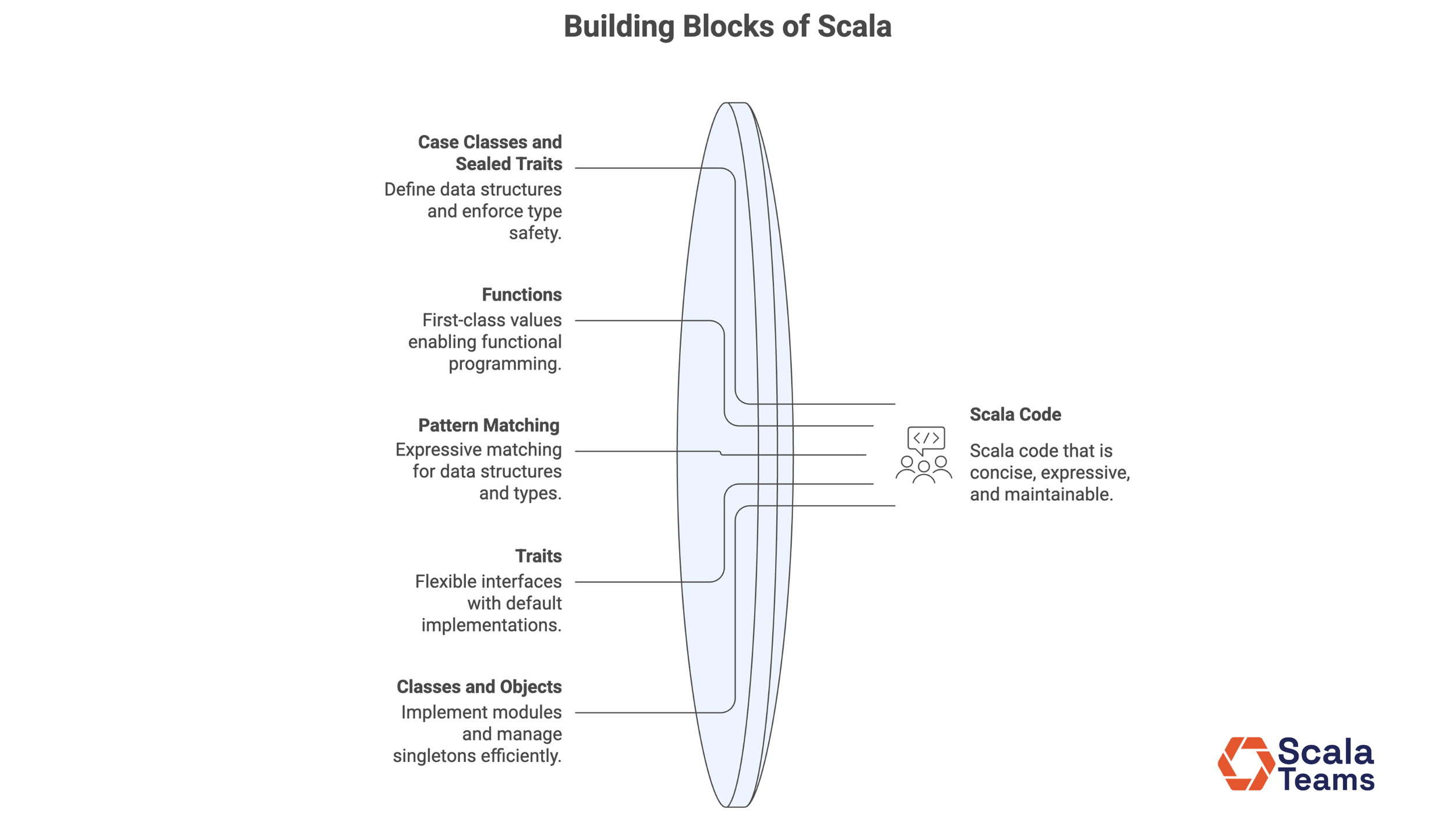
Strip away the ecosystem debates and the paradigm arguments, and Scala's core is built on a small set of constructs that most idiomatic code uses constantly.
Case Classes and Sealed Traits
Case classes and sealed traits are how you model your data. Sealed traits define a closed set of possible types; case classes define the shape of each. Together, they give you a way to represent domain concepts that the compiler understands, checks, and enforces. This is the foundation of algebraic data types (ADTs) in Scala, and it's one of the features engineers coming from Java find most immediately valuable.
Functions
Functions are first-class values. You can pass them as arguments, return them from other functions, and compose them. This is what makes functional programming in Scala practical, it's built into how the language works.
Pattern Matching
Pattern matching is one of Scala's most expressive features. You match on data structures, types, and shapes, and the compiler tells you if you've left a case unhandled. That's a runtime bug eliminated at compile time.
Traits
Traits define interfaces and module boundaries. Think of them as Java interfaces with more flexibility: they can carry default implementations and be composed in ways that Java interfaces can't.
Classes and Objects
Classes and objects implement those modules. Objects in Scala are singletons, which means clean module patterns without boilerplate factory classes.
ZIO, Pekko, Spark are ecosystem choices. Powerful ones, but choices you layer on top of the language, not the language itself. What you're actually adopting when with Scala is the core described above.
Additionally, the compiler does substantial work for you. Type inference means you don't annotate types everywhere. The implicit system lets you write concise code while the compiler fills in what's needed. This is what people mean when they describe Scala as declarative: you specify what you want, and the compiler builds the program to match.
Why Does Scala Catch Bugs That Other Languages Miss?
Odersky has described Scala's core value proposition as the combination of safety and convenience. Safety means a type system that makes illegal states unrepresentable. You're not writing defensive null checks throughout your codebase. The absence of a value is modeled with Option. Errors are modeled with Either. The compiler rejects programs that handle these cases incorrectly. Bugs that would surface as NullPointerException in Java, or as runtime errors in Python, get caught before your code ever runs.
Convenience means a concise syntax that eliminates boilerplate. In Java, modeling a simple immutable data class might require a builder, Lombok annotations, a factory, and a handful of overrides. In Scala, a case class handles it in one line. The language is designed to let you spend time on the problem you're actually solving, not on the mechanics of expressing it.
The combination is why Scala consistently shows up in complex backend systems: fintech platforms, game servers, large-scale data pipelines, and enterprise APIs. The more complicated your domain logic, the more value you get from a language that lets you model it safely, without fighting the language to do it.
What is Scala’s Learning Curve Like?
Scala’s learning curve is steeper than most languages.
Engineers coming from Python or C often report one to two years before they feel fully productive with advanced Scala concepts. Understanding higher-kinded types, monads, effect systems, and implicits takes time. They represent a fundamentally different model for thinking about code structure and correctness.
Engineers who learn Scala tend to find other languages more frustrating afterward, not because other languages are bad, but because they start to see the friction clearly. The null checks that didn't have to be there. The runtime errors that a type system would have caught. The boilerplate that existed for no reason except that the language didn't have a better mechanism.
For engineering leaders, this has a specific implication: Scala engineers self-select for depth. The people who invest in learning Scala well tend to be the kind of engineers who think carefully about correctness, architecture, and the long-term cost of technical decisions. That trait tends to show up in the rest of their work, too.
Where is Scala Used?
Scala shows up consistently in a specific set of contexts, and it's worth knowing which ones before you evaluate it for your stack.
Complex backend systems are where Scala is most at home: fintech, insurance, gaming, and enterprise platforms. Anywhere domain logic is genuinely complex, and correctness is non-negotiable. The type system pays the most dividends here.
Data engineering is the other major use case. Apache Spark is written in Scala, and for large-scale data processing pipelines, Scala gives you performance and type safety that Python-based Spark can't match. If your team is running serious data infrastructure, Scala is often already in the picture.
Full-stack development is increasingly viable. Scala.js compiles Scala to JavaScript, meaning a team can share domain models and validation logic across frontend and backend. The Scala.js frontend ecosystem, Laminar being the standout, is mature and production-ready.
CLI tools and native binaries are possible through GraalVM native compilation and Scala Native, meaning you're not locked to JVM startup times for command-line tooling.
Hardware design is a niche but notable use case. Chisel, a hardware description language written in Scala, is used to design FPGAs and RISC-V processors. Scala's expressiveness extends when the domain demands it.
Why Does Scala Code Quality Vary So Much From Team to Team?
The quality of a Scala codebase reflects the quality of technical leadership around it more directly than most languages do.
In a language like Go, the language constrains the design space. In Scala, technical leadership does. Without clear standards, you end up with a codebase where one module uses a full functional effect system, another looks like Java from 2008, and a third has type-level metaprogramming that nobody on the team can maintain. That's not a Scala problem. It's a leadership problem that Scala surfaces faster than most languages would.
The teams that get Scala right invest in three things: a well-defined coding style, a hiring strategy that recruits engineers aligned with that style, and technical leads with enough authority and credibility to enforce it. This is the same discipline that used to be standard in C and C++ shops, before languages like Go and Java started doing more of the enforcing for you. Scala puts it back in human hands.
Linters and code reviews help. But they're downstream of culture and expectation-setting. The question to ask before adopting Scala isn't just "is this the right language for our problem?" It's "do we have the technical leadership to use it well?"
So What Is Scala?
Scala is hard to explain because it genuinely isn't one thing. It's a platform for making precise technical decisions about how you want to write software. It rewards the teams that make those decisions deliberately.
At its core: a JVM language that combines functional and object-oriented programming, eliminates boilerplate, and catches bugs at compile time that other languages find at runtime. In the right hands, it produces some of the most expressive, safe, and maintainable code in production systems today.
The language question and the team question are inseparable with Scala. If you're evaluating it for a new build or trying to understand what it would take to staff and run a Scala team effectively, that's the conversation worth having before you commit.
Scala Teams provides world-class Scala engineers and teams to help you ship faster. If you're building something that needs the best, let's talk.
Work with Scala Teams
