
What to Put in an Outsourcing Contract Before Anyone Writes a Line of Code
The contract conversation usually happens at the worst possible time. You have done the interviews. You like the team. You are ready to move, and now legal review feels like the thing slowing you down. So you sign something close enough and get started.
Six months later, the relationship is fine, and the work is shipping. Then someone on your leadership team asks who actually owns the code. Or the vendor's contract has a termination clause that makes it painful to exit. Or the NDA you both signed was too generic to cover the proprietary algorithm at the core of your product, and you are now having a conversation you did not anticipate.
None of this is unusual. It happens consistently because outsourcing contracts get treated as a formality rather than a risk management document. They are not a formality. They are the structure that determines what happens in every scenario that neither party wants to think about at the start of a relationship. Here is how to get them right before the first developer joins your Slack.
TL;DR
Your outsourcing contract needs to cover six things: IP ownership, confidentiality, milestone definitions with acceptance criteria, termination rights, SLA commitments, and liability limits. Always start from your own template, not the vendor's. Have everything signed before any work starts. A good vendor will sign fair terms without hesitation.
Why Most Outsourcing Contracts Leave You Exposed
The problem with most outsourcing contracts is vagueness. Contracts that feel thorough on first read often leave the most critical questions open: who owns the code, what exactly triggers a milestone payment, what "completion" means in practice, and under what conditions either party can walk away. Vague language in a contract does not protect both parties equally. It protects whoever is more willing to argue their interpretation when a dispute arises.
The goal of a well-written outsourcing contract is not to assume the relationship will fail. It is to make sure that if something goes wrong, the resolution is factual rather than negotiated. Clear terms protect a good relationship as much as they protect you from a bad one. A vendor with nothing to hide will sign them without pushback.
Should You Use Your Contract or the Vendor's?
Using your own contract gives you control over how the six areas below are defined from the start. You are not inheriting someone else's language or their assumptions about what "completion" or "ownership" means. The downside is that drafting or commissioning a template takes time and legal budget, and a poorly written client contract can create as many ambiguities as a vendor's standard one. If you go this route, have it reviewed by a lawyer familiar with software outsourcing specifically, not just commercial contracts generally.
Using the vendor's standard agreement is faster and reflects terms the vendor has already agreed to with other clients. Established vendors with clean reputations often have well-drafted contracts that hold up fine under scrutiny. The risk is that vendor contracts are written with their interests in mind; the areas worth reviewing carefully are IP ownership, termination rights, and liability limits. These are where language tends to be vague or favorable to the vendor. Mark up anything that needs changing and treat willingness to negotiate as a signal about the relationship. A vendor with nothing to hide will accept fair amendments without friction.
Either path works if you know what to look for. The six sections below cover the specific language that needs to be precise regardless of whose template you start from.
What to Include in a Software Outsourcing Contract
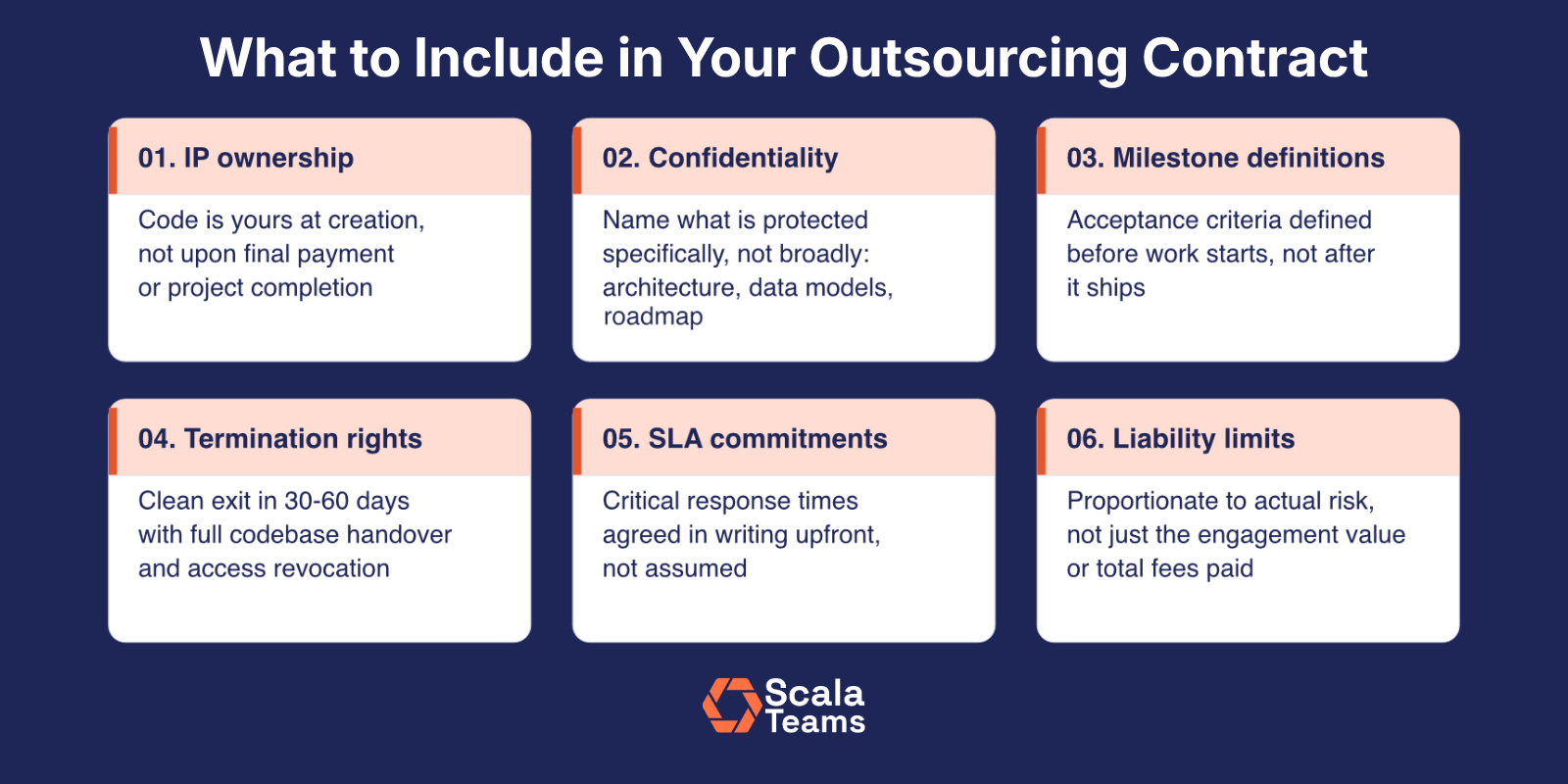
Six areas need to be covered before any work starts. Each one protects against a specific failure mode. A contract that handles all 6 clearly gives both parties a factual reference point for every scenario that might come up. A contract that leaves any one of them vague creates a gap that gets exploited, usually at the worst possible time.
1. IP Ownership and Work-for-Hire
This is the most consequential clause in the entire contract, and the one most commonly handled poorly. The requirement is simple: all code, documentation, and work product produced under the engagement belongs to you, assigned at the moment of creation rather than upon payment or project completion.
The reason this needs to be explicit: in most common law jurisdictions including the United States and the United Kingdom, code written by an independent contractor belongs to the contractor by default. "Work made for hire" automatically assigns copyright to an employer for employee-created work does not apply to contractors in the same way. Without a written assignment in the contract, you are paying for work that the contractor could, technically, claim to own.
IP ownership disputes are one of the most common sources of litigation in outsourcing relationships, and they tend to surface at the worst possible time: when you are trying to sell the company, raise a funding round, or switch vendors, and a due diligence process discovers that the IP chain is unclear.
The clause needs to state explicitly that all work product is assigned to you as it is created, that the vendor waives any moral rights where applicable under local law, and that the assignment survives termination of the engagement. Include a requirement that the vendor does not incorporate third-party code under restrictive open-source licenses into your codebase without prior written approval. GPL-licensed code embedded in a commercial product without a license to do so is its own category of IP problem.
2. Confidentiality and Non-Disclosure
A standard NDA is usually not enough. Generic NDAs define confidential information broadly as anything marked confidential or reasonably understood to be confidential, which sounds comprehensive until you try to enforce it and discover that what you considered obviously confidential was not documented as such.
Make the NDA specific. List what is covered: system architecture and design decisions, proprietary algorithms, business logic, data models, customer data structures, unreleased product plans, financial information, and any components you consider trade secrets. The more specifically you enumerate what is protected, the more defensible the NDA is and the clearer the vendor's obligation becomes.
Also address the competitive scenario directly. If the vendor works with other clients in your sector, what prevents them from applying architectural patterns or technical approaches they develop for you to those engagements? A non-compete clause scoped narrowly to your specific domain and product category, covering a defined period after the engagement ends, is a reasonable ask. Not every vendor will accept it. The conversation itself is worth having.
Consider whether the confidentiality obligations should survive termination and for how long. A two to three year post-engagement confidentiality period is standard. Perpetual confidentiality for core trade secrets is not unreasonable for genuinely proprietary components.
3. Milestone Definitions and Acceptance Criteria
Payment should be tied to milestones, and milestones need to be defined with enough precision that acceptance or rejection is a factual question rather than a subjective one. Vague milestone language is one of the most common sources of payment disputes in outsourcing engagements.
Compare these two definitions of the same milestone:
Vague: "Completion of the backend API."
Precise: "Delivery of the backend API endpoints specified in Appendix A, each passing the integration tests defined in Appendix B, with API documentation meeting the standards in Appendix C, and with no open P1 or P2 bugs as defined in the defect severity matrix in Appendix D."
The second version can be evaluated objectively. Either the tests pass or they do not, either the documentation meets the standard or it does not. The first version is an invitation to a disagreement about whether the work is done.
Include a review window after each milestone delivery, typically 5-10 business days, during which you can evaluate the submission against the acceptance criteria and request revisions. Work accepted without a formal review has no basis for later rejection. Work reviewed against documented criteria can be accepted, rejected with specific feedback, or revised under a defined process.
Also define what happens when work fails acceptance more than once. A revision limit, a process for escalation, and a clear outcome for repeated failure protects both parties from a revision loop that consumes budget without resolution.
4. Termination Rights and Exit Provisions
You need to be able to exit the engagement cleanly under two scenarios: a planned exit at the end of a project, and an unplanned exit if the relationship breaks down or the vendor fails to perform. Both need to be covered explicitly.
For planned exits, define the handover protocol: full codebase transfer, documentation package, access revocation timeline, and a structured knowledge transfer session with your internal team. This should be a defined deliverable in the contract, not an informal expectation. Getting the handover protocol in writing when both parties are happy is significantly easier than negotiating it when one party is not.
For unplanned exits, require reasonable notice periods (30 to 60 days is standard; anything beyond 90 days should be questioned) and no financial penalties for termination for convenience beyond the notice period. You should also confirm in the contract that repository admin access is held by you, not the vendor. A contentious exit where the vendor controls your code repository is a serious leverage problem that a contract provision prevents at no cost when the relationship is healthy.
Address the vendor insolvency scenario explicitly. If the vendor goes out of business mid-engagement, what happens to your code? Source code escrow, where the code is deposited with a neutral third party and released to you under defined conditions, is worth considering for any mission-critical engagement. At minimum, confirm in the contract that all code is committed to your repositories on a defined cadence and that you can recover everything you need to continue development without the vendor's active cooperation.
5. SLA Commitments
Service level agreements define the vendor's minimum performance obligations during the engagement. They matter most when something goes wrong, which is exactly when you want defined expectations rather than informal ones.
Define severity tiers for issues: a critical production bug and a cosmetic UI inconsistency warrant different response timelines. Spell out what constitutes each tier and what the response and resolution commitments are. For critical issues, a two to four hour initial response and a defined escalation path is a reasonable standard. For non-critical issues, 24 to 48 business hours is typical.
Beyond bug response, document the communication SLAs: how quickly the vendor should respond to questions, how often they provide async status updates, and what the process is for flagging blockers. These feel trivial to include when the relationship is strong and everyone is communicating well. They become important when a vendor goes quiet mid-sprint and you need something in writing to reference.
Include remedies for SLA breaches. If critical response SLAs are missed consistently, what is the mechanism? A credit against future invoices, a rate reduction, or exit rights for persistent breach are all reasonable provisions. Define what "consistent" means numerically so the threshold for remedy is clear.
6. Liability Limits
Vendors typically cap their liability at the total fees paid under the contract. That is a defensible starting position for low-stakes work. Review it against the actual risk profile of what you are building.
A bug in an internal reporting dashboard has limited downstream consequences. A bug in a payment processing system or a data pipeline handling sensitive personal information can have significant financial, legal, and reputational consequences that far exceed the engagement value. The liability cap needs to be proportionate to the actual risk, and that requires a conversation rather than accepting the vendor's standard terms.
Clarify which party bears responsibility for security incidents and data breaches. If the outsourced team has any access to customer data, even in a development environment, the contract should specify security obligations, breach notification requirements, and liability allocation for incidents attributable to their access or their code.
Red Flags in a Vendor's Standard Contract
If you are reviewing a vendor-provided contract, watch for these specifically:
IP ownership that assigns rights to the vendor or requires a separate assignment process upon payment. Code ownership should transfer at creation, not on a condition you have to trigger.
Repository ownership held by the vendor. Your code should live in repositories you administer. Full stop.
Milestone definitions that reference the SOW without specifying acceptance criteria. "As described in the Statement of Work" is not an acceptance criterion. Objective, testable standards are.
Termination notice periods longer than 60 days or financial penalties for termination for convenience. Reasonable notice is appropriate. Punitive exit terms are not.
Liability caps set at a small fraction of the engagement value for work involving sensitive data or critical system components.
Automatic renewal clauses without a required reminder or opt-out window. These create ongoing financial obligations that can easily be missed.
Dispute resolution clauses that require arbitration in the vendor's jurisdiction. Neutral arbitration or the client's jurisdiction is a reasonable counter.
A vendor who refuses to negotiate any of these terms is a vendor worth walking away from. Every clause above is standard in well-drafted outsourcing agreements. Resistance to fair terms, before the engagement starts and both parties are on good terms, is a meaningful signal about how the vendor will behave when the relationship is under pressure.
The Clauses That Matter Most
If you are prioritizing where to spend your legal review time, focus on three clauses above the others. IP ownership determines whether you actually own what you are paying to build. Termination rights determine whether you can exit cleanly if the relationship fails or the vendor underperforms. Milestone definitions with acceptance criteria determine whether you have a factual basis to reject work that does not meet the bar. Get those three right and the rest of the contract is easier to negotiate and easier to enforce. Get any one of them wrong and the other five clauses cannot compensate.
Scala Teams works through straightforward commercial terms. IP belongs to you from day one, repositories are yours to administer, and exit provisions are clean. Talk to a Scala expert about how we structure engagements.
Related reading: What Senior Scala Developers Cost in the US in 2026, The Internal Readiness Checklist, and 5 Signs Your Engineering Team Is Ready to Outsource Software Development for the pre-engagement planning.
