
5 Signs Your Engineering Team Is Ready to Outsource Software Development
Most engineering leaders have thought about outsourcing. Many have had the conversation with their board or their CFO. Some have tried it and had mixed results. A smaller group have made it work reliably and built outsourcing into how they operate as a matter of course.
The difference between the second and third groups usually isn't the vendor, it's the timing. Outsourcing before you're ready produces misaligned output, management overhead, and a frustrating experience that confirms every skeptic's priors. Outsourcing when the conditions are right produces shipped work, reduced hiring pressure, and a team that moves faster than it could alone.
Here are the five signals that the conditions are right. And at the end, two signals that they aren't yet.
TL;DR
You're ready to outsource when your roadmap outpaces headcount, specialist work is falling to generalists, hiring is the bottleneck, you can write clean specs, and you have a technical reviewer who can own the output. Missing the last two means you're not ready yet. The work to get there is worth doing first.
1. Your Roadmap Outpaces Your Headcount Consistently
A backlog that grows faster than the team can clear it is the most obvious signal. But the word to pay attention to is "consistently." Every team has sprints where more comes in than goes out, that's normal.
What isn't normal is a structural gap between your team's sustained capacity and the work your business actually needs done. If you're routinely choosing between roadmap items not because of priority but because there simply aren't enough engineers to tackle them in parallel, you have a capacity problem. That's a problem outsourcing is well-suited to solve.
The downstream effects of this gap compound quickly. Engineers who are perpetually behind start cutting corners on testing and documentation to keep up. Technical debt accumulates and team morale takes a hit as the backlog grows and releases slip. By the time a leader escalates the capacity issue to the board, the codebase has already paid a quiet, expensive price.
However, outsourcing solves execution capacity, not strategy clarity. If the roadmap is crowded because nobody has decided what to prioritize, that's a different problem. Throwing more developers at an undefined roadmap doesn't produce more output. It produces faster confusion. It’s important to lock priorities in before bringing in external capacity to execute on them.
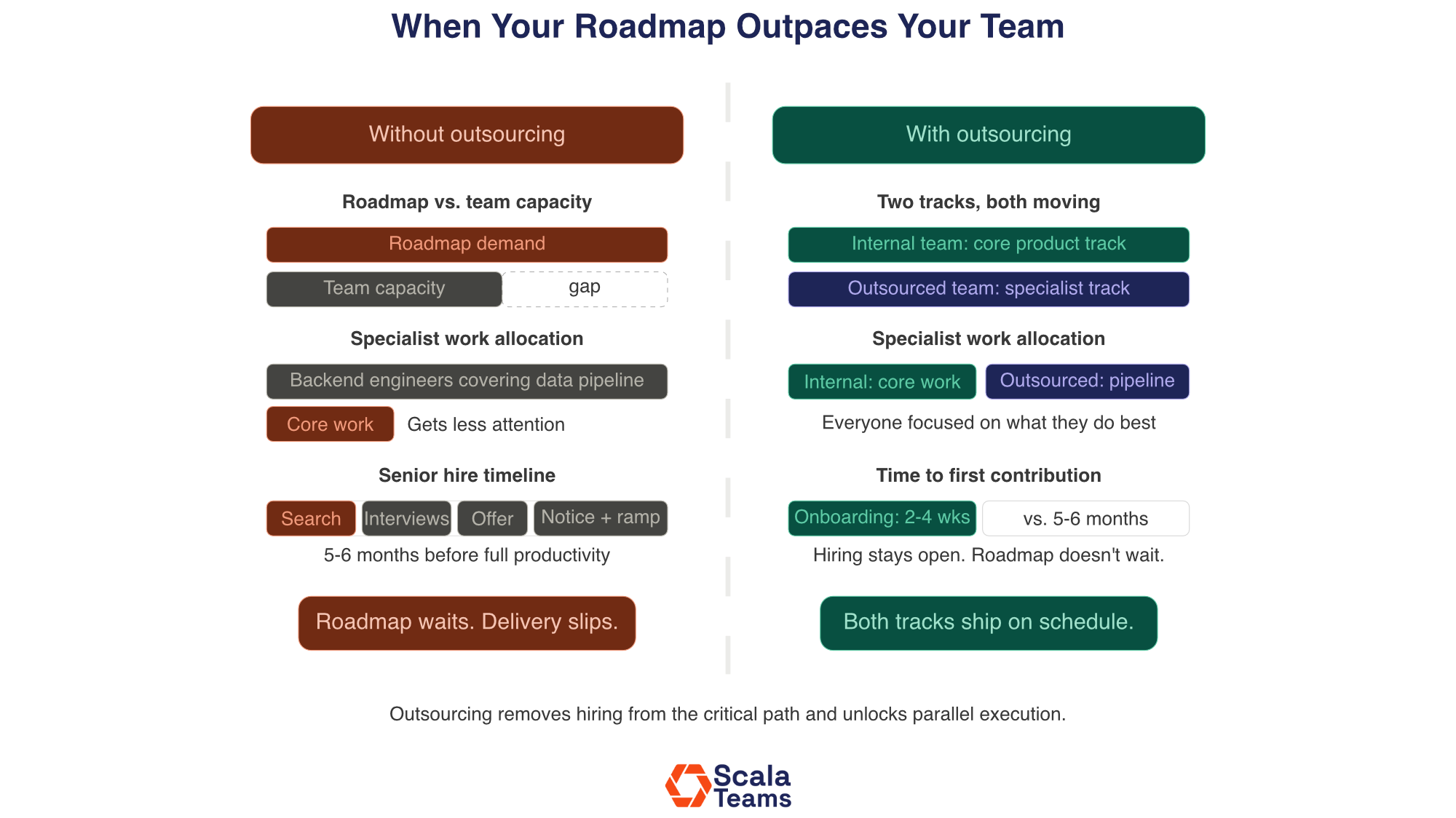
2. Specialist Work Is Falling to Generalists
This signal is quieter than the first one, and often more expensive. Your backend engineers are writing the data pipeline because nobody else will. Your infrastructure team is handling distributed systems work that they're capable of handling, but not optimized for. Your most senior and highest-paid developers are spending a meaningful portion of their week on problems that a specialist would solve in half the time and with stronger results.
This pattern tends to develop gradually. It usually starts with a one-off task that gets absorbed by whoever has bandwidth. That task becomes a recurring responsibility. Before long, a backend engineer owns a data engineering workstream that was never part of their job description, and the original work that justified their salary is getting less attention than it should.
It's usually invisible until something breaks or someone leaves. The developer who had been quietly absorbing the specialist work moves on, and the team discovers mid-sprint that nobody else knows how that system works.
Outsourcing to a team with the right specialization addresses this at the root. You bring in engineers who do exactly this type of work every day, who carry deep contextual knowledge your generalists would take months to build, and whose output in that domain is faster and more reliable. Your internal team gets their bandwidth back and can refocus on the work that's in their wheelhouse.
3. Hiring Is on the Critical Path
If a senior role has been open for three months, the work attached to that role isn't pausing while you search. You're either asking existing engineers to absorb it, which degrades quality and morale, or the work is sitting undone, which costs you time to market and competitive ground.
Hiring timelines for senior engineering roles have stretched considerably in recent years, particularly for specialist skills. A thorough search, technical screening, offer negotiation, notice period, and genuine onboarding ramp can easily consume five to six months from posting to full productivity. That timeline is simply incompatible with a product roadmap that needs to move.
Outsourcing doesn't replace hiring, and it's not always meant to. For many companies, long-term, building in-house capability is the right end goal. But outsourcing removes hiring from the critical path for the work that needs to happen now. You can have a qualified team contributing to your backlog in the time it takes to extend a single offer, and your quarterly delivery targets don't have to depend on a recruitment process to close on schedule.
This is particularly relevant for specialist skills in languages like Scala, where the talent pool is smaller and sourcing takes longer. The engineers who are genuinely senior in Scala, functional programming, and distributed systems are not sitting idle on job boards. Finding, evaluating, and onboarding them in-house is a multi-month process. Outsourcing to a team that has already done that sourcing and vetting gives you access to that expertise on a timeline your roadmap can actually work with.
4. You Can Write a Clean Specification
Can you write down what you need the outsourced team to build with enough precision that someone who has never worked at your company could produce something you'd accept? That means scope, acceptance criteria, technical constraints, edge cases, out-of-scope items, and a definition of done at each milestone.
If the answer is yes, you're genuinely ready to hand that work off. If the answer is "we'll clarify as we go," you're not. Outsourced teams don't have the accumulated context your in-house team has. They don't know which edge cases have caused you problems in the past or which integration points are fragile. Every gap in the specification becomes a decision they make using their own judgment. Sometimes that judgment is fine. Often it isn't, and you only find out at review.
The specification quality is the single biggest driver of output quality in any outsourced engagement. Not the vendor's seniority, not the hourly rate, not the contract structure. Teams that write thorough, precise specs before work starts spend less time in revision cycles and more time shipping.
There's a secondary value to the spec exercise that often goes unnoticed. Teams that sit down to write a specification and find it hard are usually discovering that their requirements aren't as well-defined internally as they thought. That clarity gap would have caused friction with an in-house team too. The spec forces the conversation that should have happened before any developer, internal or external, starts building.
5. You Have a Technical Decision-Maker on Your Side
Someone on your team needs to be able to evaluate what the outsourced team produces and make technical calls that favor your interests. Not someone who can read a status update or approve a milestone payment, but someone who can look at a pull request, understand what it's doing, spot where it's over-engineered, and have a direct conversation with the vendor lead about trade-offs.
This person doesn't need to be a full-time CTO or carry a senior title. A consulting engineer, a part-time technical advisor, or a senior developer within your org who owns the review process for a few hours a week is enough. The requirement is that they exist, they're named before work starts, and they have the authority to push back.
Without this person, scope drifts in ways that feel reasonable at each individual step but compound into something far larger and more expensive than what you agreed to. The vendor makes architectural calls that seem sensible from their side of the table, proposes custom builds where off-the-shelf tools would have done the job, and expands the scope in directions that serve their billing more than your goals. Nobody on your side has the standing to question any of it, so the decisions stack up quietly until the budget is gone and the relationship is tense.
The opposite is also true. When there's a technical decision-maker on your side from day one, decisions get challenged early while they're still cheap to change, the spec gets used as a reference point rather than a loose starting position, and the vendor and client build trust through honest back-and-forth rather than polite agreement followed by late-stage friction. That's what a well-run engagement actually looks like. It holds through the whole project, not just the first sprint when everyone is still on their best behavior.
The Flip Side: Two Signs You're Not Ready Yet
You can't write the spec
If the work you want to outsource is too undefined to document precisely, it's too undefined to hand off. This isn't a vendor problem or a process problem. It's a product and engineering clarity problem, and it needs to be solved internally before any external team comes into the picture.
Trying to outsource work that isn't properly scoped is one of the most expensive mistakes in the playbook. The vendor builds something that isn't right, you ask for revisions based on verbal clarifications rather than a written spec, and the cycle repeats until the budget is exhausted or the relationship breaks down. Each round feels like progress, but without a spec to anchor the work, there's no shared definition of done to actually reach. Because the spec was never written, there's no clean way to determine who was responsible for the misalignment. By that point, it doesn't really matter anyway.
Do the scoping work first, it often takes a week or two of focused effort. That investment is returned many times over in the first month of a well-specified engagement.
You have no technical reviewer
If nobody on your side can evaluate the code or the architectural choices being made, you're outsourcing more than development work. You're outsourcing your technical judgment. That's where timelines, budgets, and codebases come unstuck in ways that are hard and expensive to recover from.
This is a solvable problem. You don't need to hire a full-time CTO. A fractional technical advisor, a consulting engineer on a light retainer, or a senior developer from another part of your org who can own the review process is enough. What you need is a human being on your side who can read the output and tell you whether it's good.
Both of these gaps take two to four weeks to close for most teams. The spec needs focused product and engineering time to write. The reviewer needs to be identified and contracted. Once those two things are in place alongside the five positive signals, the outsourcing decision is straightforward and the engagement has a strong foundation to build on.
Scala Teams works with engineering leaders who are ready to move. If you're evaluating a Scala outsourcing engagement and want to talk through the specifics, talk to a Scala expert.
Before the vendor search: The Internal Readiness Checklist.
