
7 In-Demand Programming Languages of 2026
Not all programming skills are created equal right now. Some languages have more developers than open jobs. Others have more jobs than developers they can fill. The difference matters whether you are hiring, building a team, or deciding where to put your technical energy.
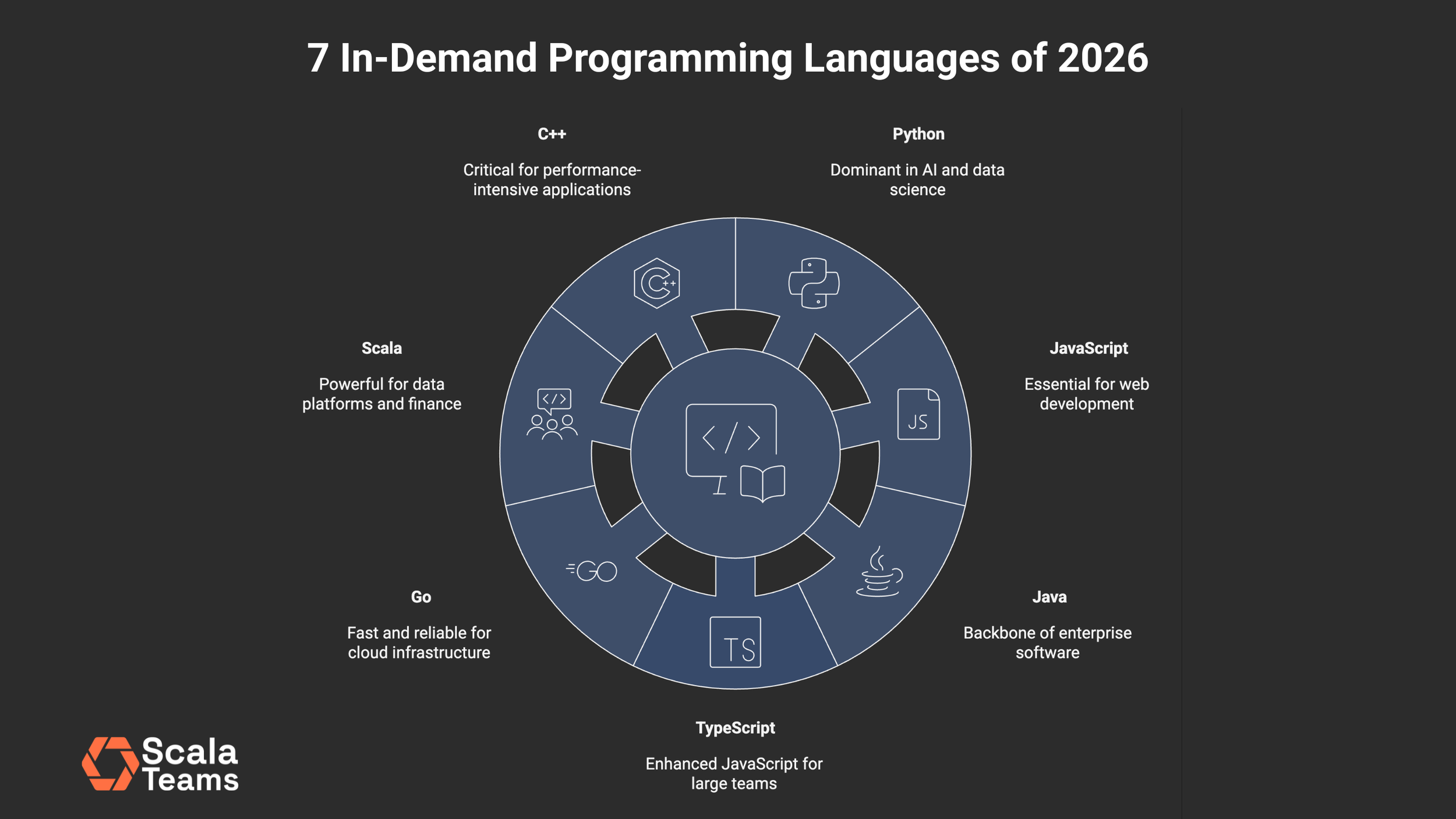
This breakdown covers seven languages doing the most work in the market right now: what they are built for, where they shine, and where they fall short. Each entry also notes the honest supply/demand picture, because that shapes cost, availability, and strategic value more than any benchmark ever will.
- Python is the most popular language of 2026, with deep roots in AI, data engineering, and analytics, but high supply means it is no longer a differentiator on its own.
- JavaScript and TypeScript are the universal web standard. TypeScript has become the mature default for any serious frontend or Node.js codebase.
- Java holds steady as the enterprise backbone, particularly in financial services. Not exciting, but not going anywhere.
- Go is the fastest-growing option for cloud infrastructure and microservices, with strong demand and a supply gap that is only beginning to close.
- Scala occupies the most specialist position in the market: high demand, very low supply, and a strong premium in big data, fintech, and front office systems.
- C++ remains essential for high-frequency trading, game engines, embedded systems, and any domain where raw performance is non-negotiable.
Python
Python is the default language of the AI era. It sits at the center of almost every data-intensive workflow, from exploratory analysis in a Jupyter notebook to deploying machine learning models at scale. Its syntax is close to plain English, its ecosystem is enormous, and it attracts more new developers than any other language right now.
Roughly half of working Python developers have fewer than two years of commercial experience. That says a lot about the barrier to entry. It also says something about the depth distribution in the talent pool.
Where Python Works Best
The dominant language for machine learning and AI development, with PyTorch and TensorFlow as standard tools
Central to data engineering pipelines, analytics, and business intelligence work
Web backends via Django and FastAPI, particularly for API-first applications
Scripting, automation, and glue code across nearly every engineering environment
The fastest path to a working prototype, experimentation costs are low
Where Python Falls Short
Slow at runtime compared to compiled languages; production AI systems often have Python as the interface layer sitting on top of faster C++ or Rust internals
The Global Interpreter Lock (GIL) limits true multi-threading, which is a real constraint for certain concurrent workloads
Dynamic typing makes large codebases harder to maintain without discipline; bugs that a type system catches at compile time show up at runtime instead
The shallow end of the talent pool is very large; evaluating depth takes more work than with scarcer languages
JavaScript
JavaScript has been the language of the web for decades, and nothing in 2026 has changed that. Every browser runs it. Node.js extended it to server-side development. React, Vue, and Angular built entire product ecosystems on top of it. If you are building anything for the web, JavaScript is somewhere in the stack.
Notably, it remains the most common language in large investment banks and asset managers, institutions that standardized on the JS ecosystem years ago and have no pressing reason to migrate.
Where JavaScript Works Best
The only language that runs natively in every browser, with no compilation step required for the frontend
Full-stack development via Node.js, allowing teams to share language, tooling, and often code across front and back end
A vast ecosystem of libraries and frameworks with strong community support
Dominant in financial services frontend systems and internal tooling at major institutions
Low barrier to entry, large hiring pool
Where JavaScript Falls Short
Dynamic typing leads to subtle bugs in large codebases, one reason TypeScript has become the default for serious projects
Historical inconsistencies in the language design create real footguns that require experience to navigate
Asynchronous patterns (callbacks, Promises, async/await) have a learning curve that trips up less experienced developers
Not designed for compute-heavy workloads; performance ceilings are real for anything beyond I/O-bound tasks
Java
Java has been the backbone of enterprise software for over 25 years. Banks, insurers, logistics companies, and healthcare systems run enormous amounts of mission-critical Java code. The language is not exciting, and it is not trying to be. It is reliable, deeply tooled, and defended by decades of institutional investment that is not going to be unwound for a trendier alternative.
Newer JVM languages (Kotlin, Scala, Groovy) have eroded Java's position at the margins, but the core enterprise base remains intact.
Where Java Works Best
Dominant in large enterprise backend systems: financial services, ERP, logistics, insurance
The standard language for Android app development (alongside Kotlin)
Mature ecosystem with deep tooling, monitoring, and performance optimization support
Strong static typing and JVM performance make it suitable for high-throughput systems
Enormous talent pool, hiring at scale is straightforward
Where Java Falls Short
Verbose by modern standards, routine patterns require more boilerplate than equivalent code in Kotlin, Scala, or Go
Slower to adopt modern language features compared to JVM competitors; the pace of iteration on the language has picked up (Project Loom, records, sealed classes), but the ecosystem often lags behind
Less suited to modern cloud-native microservices compared to lighter runtimes like Go, though frameworks like Quarkus and Micronaut have improved startup times
Newer JVM alternatives (Kotlin, Scala) offer meaningful productivity and safety improvements for greenfield work
TypeScript
TypeScript is what JavaScript looks like when teams get serious. Microsoft built it as a typed superset of JavaScript; every valid JS file is a valid TypeScript file, so adoption is incremental, and the migration path is real. It is becoming the default choice for JavaScript codebases maintained by teams larger than a few people.
It has not replaced JavaScript. It sits on top of it, compiling down to plain JS. But for large frontend systems, complex Node.js backends, and anything where a wrong type assumption causes a production incident, it has become standard.
Where TypeScript Works Best
Catches entire categories of bugs at compile time that JavaScript would only surface at runtime
Makes large codebases significantly more maintainable, and IDEs can provide accurate autocomplete, refactoring, and error detection
The standard for production-grade React and Angular applications
Increasingly used for Node.js backends, where type safety across the full stack reduces integration bugs
Works across the entire JavaScript ecosystem, you are not giving up libraries or frameworks
Where TypeScript Falls Short
Adds a compilation step and build configuration overhead that is noticeable for small projects or rapid prototyping
The type system can get genuinely complex; advanced generic types and conditional types have a steep learning curve
Still compiles to JavaScript, which means the same runtime performance characteristics apply; TypeScript does not make your code faster
Type coverage is only as good as the discipline applied, and poorly typed TypeScript codebases offer much of the pain with little of the benefit
Go (Golang)
Go was built at Google to solve a specific problem: building fast, reliable network services without the complexity of C++ or the overhead of Java. It has a minimal feature set by design. There is usually one obvious way to do something. It compiles to a single binary, starts fast, and handles concurrency natively through goroutines.
Go is a fast-growing language for cloud infrastructure and microservices work. Docker, Kubernetes, Terraform, and much of the tooling that defines modern cloud-native architecture is written in Go. Teams building on top of that infrastructure often end up in Go themselves.
Demand is particularly strong in trading and fintech, where high-performance backend services have created a real premium for Go engineers and supply has not yet caught up.
Where Go Works Best
Exceptional for high-throughput network services, APIs, and backend infrastructure
Native concurrency model (goroutines and channels) makes concurrent programming straightforward compared to thread-based models
Small, readable language, onboarding new developers to an existing Go codebase is faster than most alternatives
Fast compilation, fast startup, low memory footprint, well-suited to containerized and serverless deployments
Strong standard library that covers most network and I/O needs without third-party dependencies
Where Go Falls Short
The minimal type system is a deliberate trade-off, but it limits abstraction. Generic types were added in Go 1.18, but are not as expressive as those in Scala, Haskell, or Rust
Error handling is explicit but verbose; returning error values from every function produces repetitive code
Less suited to complex domain modeling compared to languages with richer type systems
Smaller ecosystem than Python, Java, or JavaScript, some domains have limited library support
Scala
Of all the languages on this list, Scala has the most interesting supply/demand story in 2026. Demand has surged, driven by its position as the native language of Apache Spark, its role in large-scale data platforms, and growing adoption in front office analytics and event-driven backend systems in financial services. Supply has not kept pace.
A few years ago, requirements for Scala engineers were uncommon outside a narrow set of data engineering roles. Today, the picture is different. Data platforms have scaled. Front office teams have rebuilt analytics infrastructure on Spark-native pipelines. Event-driven architectures in trading and payments have found Scala's type system and functional programming model to be a strong fit for correctness under pressure.
The result is a meaningful specialist premium. Experienced Scala engineers command higher rates and are harder to find than equivalent engineers in Python, Java, or Go.
Where Scala Works Best
The dominant language for Apache Spark, if you are running distributed data processing at scale, Scala is the most performant path
Strong type system and functional programming model make complex domain logic easier to reason about and test
Runs on the JVM, which means seamless interoperability with Java's mature ecosystem while offering modern language features that Java lacks
Akka/Pekko makes actor-based distributed systems practical at scale, used heavily in streaming and real-time backend work
Preferred language for front office analytics systems and event-driven architectures in financial services
Strong type inference reduces boilerplate while maintaining full compile-time safety
Where Scala Falls Short
High learning curve: Scala's feature set is large, and the path from basic competence to real mastery takes time
Compile times are slower than Go or Java, which affects developer feedback loops on large projects
The breadth of the language has historically led to fragmented codebases where different teams or developers use very different Scala idioms, a maintenance risk when lacking strong engineering standards
Low supply means hiring takes longer and costs more; building an in-house Scala team on a tight deadline is genuinely hard
A smaller community than Python or Java means fewer quick answers to niche problems
C++
C++ is not a language people choose by default. They choose it when the performance requirements rule everything else out. Game engines, simulation software, embedded systems, and high-frequency trading infrastructure all share one property: latency or throughput constraints tight enough that the overhead of a managed runtime is not acceptable. For those domains, C++ is still the answer.
It has not grown. It is not going to. But it is deeply embedded in the infrastructure of domains where performance is a hard constraint, and that is not changing.
Where C++ Works Best
Raw performance, direct memory management, and no garbage collector means predictable, minimal latency
The standard language for real-time game engines (Unreal Engine is C++), AAA game development, and physics simulation
Essential for embedded systems and robotics, where memory and compute resources are tightly constrained
High-frequency trading infrastructure where sub-microsecond latency makes managed language overhead unacceptable
Used in the performance-critical internals of tools written in other languages, Python's numeric libraries ultimately call C or C++ code
Where C++ Falls Short
Among the hardest languages to write correctly, manual memory management opens the door to buffer overflows, use-after-free errors, and memory leaks that are difficult to debug
Long compile times on large projects, especially before build caching and modules were widely adopted
The language has accumulated decades of legacy design decisions alongside modern features, making it one of the most complex languages to understand fully
Rust is increasingly competitive for new systems programming work, offering memory safety guarantees without a runtime cost. C++ will face more displacement here over time
Small, specialist hiring pool, strong C++ engineers are rare and command a high premium
What the Language Rankings Tell You About Hiring in 2026
Most of what makes a language choice strategic comes down to one question: what does the supply/demand picture look like for the engineers who build with it?
Python and JavaScript sit at one end, with a massive supply, accessible hiring, but no inherent scarcity premium. They are the commoditized side of the market. For work where output volume matters more than specialist depth, that is fine. For systems where you need people who genuinely know what they are doing at scale, depth is harder to find than it looks.
Scala, C++, and Go sit at the other end. These languages attract engineers who deliberately choose difficulty, which tends to select for a different kind of problem-solving disposition. The demand is real, the supply is constrained, and the technical results tend to reflect that.
If your team is building on Spark, running event-driven data infrastructure, or doing anything in front office analytics, the supply gap in Scala is a practical constraint you will run into. Getting ahead of that hiring problem early matters more than most teams realize until they are already behind.
If you are navigating that gap, Scala Teams helps companies scale their Scala development efforts. Start with a conversation, not a job posting.
Scala Teams specializes in placing dedicated Scala engineers and teams with companies that need technical depth, not headcount. Every engagement starts with a technical alignment conversation.
Schedule a Call with Scala Teams
Frequently Asked Questions
What is the most popular programming language in 2026?
Python is the most popular programming language in 2026. It dominates AI, machine learning, data engineering, and analytics, and the developer pool is growing faster than any other language on this list.
Which programming language has the highest demand relative to supply in 2026?
Scala has one of the highest demand-to-supply ratios in the market. Demand has surged with the growth of large-scale data platforms, front office analytics, and event-driven backend systems, but the pool of experienced Scala engineers has not grown at the same pace.
Is Go (Golang) worth learning in 2026?
Yes. Go is a fast-growing language for cloud infrastructure and microservices. Demand is strong, and supply sits below that of mainstream stacks, particularly in trading and fintech. It is a strong specialization for backend engineers targeting high-performance systems.
Is Java still relevant in 2026?
Java remains a stable enterprise backbone. Demand is consistent in financial services, large-scale backend systems, and Android development. It is not growing, but enterprise migration cycles are long, and Java is deeply embedded in the institutions that run on it.
What is the difference between TypeScript and JavaScript in 2026?
TypeScript has become the standard for large-scale or team-based web development, adding static types to JavaScript to catch errors earlier and improve maintainability. JavaScript remains universal and still appears in environments where TypeScript's overhead is not worth it, but for any serious production codebase, TypeScript is the default.
