
Scala Development Outsourcing: What It Is and What Generic Guides Get Wrong
Most IT outsourcing guides assume a liquid talent market: a large pool of developers you can screen, compare, and swap between vendors. Scala doesn't work that way. The pool is small, the expertise is specialized, and the advice written for languages like Java or Python teams doesn't directly transfer.
The difference matters. Scala's type system, functional programming patterns, and JVM runtime behavior create a narrower, more demanding talent pool than most languages. That changes how you structure an engagement, how you vet a partner, and how you think about cost. Most generic guides cover this, but the goal of this blog is to dive deeper.
- Scala development outsourcing requires a more specialized talent pool than standard IT outsourcing, and different vetting criteria to match.
- The three main engagement models (staff augmentation, dedicated team, project outsourcing) all apply to Scala, but carry different risks depending on your internal team's depth.
- Rate-first evaluation will get you Scala-adjacent developers, not Scala engineers. Vetting must include functional programming fluency, not just language familiarity.
- The total cost of Scala outsourcing compares favorably to lower-cost alternatives once you factor in correctness, type safety, and long-term maintenance.
What Is Scala Development Outsourcing?
Scala development outsourcing is the practice of engaging an external team to build, maintain, or scale software written in Scala. The external team could be a single embedded engineer, a dedicated pod, or a partner handling an entire product stream.
Scala is a multi-paradigm language that runs on the JVM. It combines object-oriented design with functional programming in a way that gives engineers significant expressive power and a lot of rope to hang themselves with. A team that writes Scala like Java is technically using the language. They are not getting its benefits. A team that writes idiomatic Scala (using type classes, immutable data structures, and effect systems correctly) produces code that is more concise, more testable, and more maintainable. But that team is much harder to find.
When you outsource Scala development, you are not just hiring headcount. You are hiring judgment about functional design, type system use, and the tradeoffs that Scala makes available. That judgment is scarce, and it is the thing that generic outsourcing guides have no framework for evaluating.
Why Scala Outsourcing Is Structurally Different
Outsourcing works best when the talent market is liquid. When there are enough qualified engineers that vendors can staff a team quickly, swap out a poor fit, and compete on price and process rather than just availability. For most languages, that market exists. For Scala, it does not, and that changes many ways that outsourcing decisions should be made.
The frameworks that work for Java outsourcing assume you can find 10 qualified candidates, interview 5, and hire 2. The frameworks that work for Python outsourcing assume a global freelance market deep enough that rate and timezone are the primary variables. Neither of these assumptions hold true for Scala. The number of engineers who can write idiomatic, production-grade Scala is small, unevenly distributed, and not sitting on job boards waiting to be sourced.
Understanding why the Scala market looks this way and what it means for each layer of the outsourcing decision is the starting point for making a good choice.
The Scala talent pool is shallow
Java has millions of developers globally. Python is not far behind. Scala has a fraction of that. The language has a steeper learning curve, a smaller community, and attracts engineers who deliberately choose functional programming over easier paths. That’s good for code quality, but bad for availability.
This scarcity has a direct effect on outsourcing. Most generalist IT outsourcing vendors can staff 10 Java engineers with a week's lead time. They can’t do that with senior Scala engineers. Vendors who claim they can are usually sourcing engineers with superficial Scala exposure from their Java bench. The difference shows up in code review.
A study of developer survey data consistently shows Scala engineers among the highest-earning and least-represented in the global market. You are not shopping in a buyer's market.
Functional programming fluency is not optional
Most enterprise software is written imperatively: state gets mutated, side effects are scattered. The code works until it doesn’t, and then debugging it is an adventure.
Scala's value proposition is built on moving away from that. Immutability, pure functions, and composable effect handling. These patterns produce systems that are easier to reason about and harder to break. However, they require engineers who think functionally, not just engineers who have downloaded the Scala compiler.
When you outsource Scala development to a team that lacks genuine FP fluency, you get the worst of both worlds: Scala's learning curve cost without its reliability benefits. The code will compile, but it will not be idiomatic. Six months later, your internal team will be maintaining something that looks like Java written in Scala syntax.
This is the most common failure in Scala outsourcing. It is also the one that a standard technical interview misses if the interviewers don’t know what to look for.
The ecosystem is specialized
Generic IT outsourcing can substitute between React versions, swap ORM libraries, or shift from REST to GraphQL without massive disruption. The Scala ecosystem doesn’t work that way. The choice between Akka and Pekko, between cats-effect and ZIO, between Slick and Doobie, reflects genuine architectural decisions with long-term consequences. Engineers who have only ever used one stack may struggle with another, even within Scala.
When you evaluate a Scala outsourcing partner, you need to know which ecosystem they actually know, and not just which ones they list on their website.
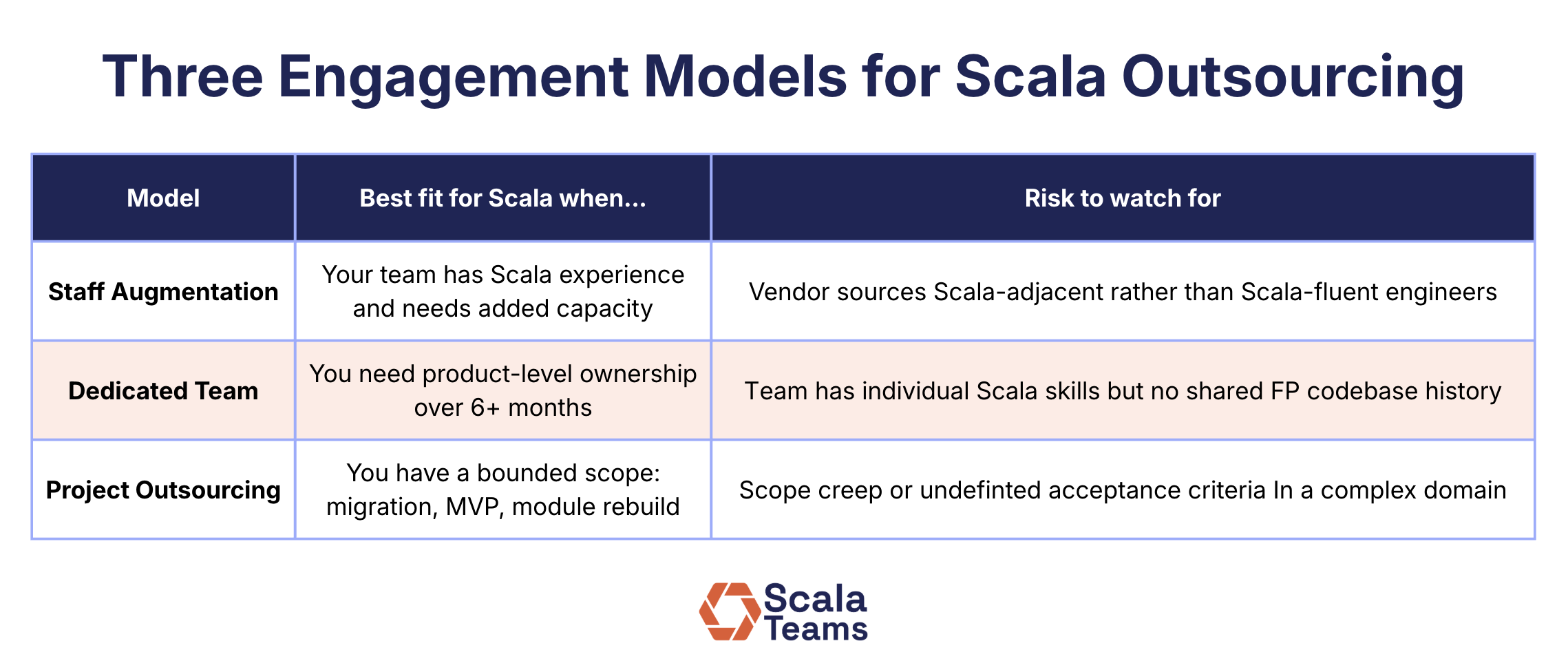
The Three Engagement Models for Scala Outsourcing
The standard outsourcing engagement models all apply to Scala. Staff augmentation, dedicated teams, and project-based outsourcing are all viable depending on your situation. But each one carries risks that generic guides do not cover because they don’t consider what happens when the talent pool is small, expertise is deep, and the wrong hire sets your codebase back rather than forward.
With commodity stacks, the worst-case scenario for a bad outsourcing hire is usually wasted time and mediocre code you can refactor. With Scala, the worst case is an idiomatic surface that hides structural problems. Code that compiles, passes review from someone who does not know Scala well, and quietly accumulates the kind of technical debt that takes months to unwind. The engagement model you choose determines how much exposure you have to that risk.
Staff augmentation
You embed external Scala engineers directly into your team. They work in your codebase, join your standups, and report to your tech lead.
This works well when your internal team already has Scala experience and you need capacity, not direction. Your tech lead can review their work and catch problems early. The external engineer can ramp up on your conventions without owning the architecture.
It breaks down when your internal team doesn’t have the Scala fluency to guide and review the work. Staff augmentation assumes competent oversight on your side. Without that, you are not augmenting. You are delegating to someone you cannot evaluate.
Before pursuing staff augmentation, ask whether your team can conduct a meaningful technical interview with a senior Scala candidate. If the answer is no, a staff augmentation model will not give you the quality control you need.
Dedicated Scala team
You engage a self-contained engineering team made up of developers, QA, and a tech lead. They own a product area or stream of work over an extended period.
This is the right model for most Scala outsourcing relationships. It places architectural accountability with the vendor's team, which means the tech lead's Scala expertise is the vendor's problem to provide, not yours. You define priorities and outcomes, while they own the delivery and the design decisions within your agreed constraints.
The key variable is whether the vendor's team has actually built production Scala systems together, not whether they can assemble a group of Scala-familiar engineers on short notice. Engineers who have collaborated on an effect system design before will work faster and produce more coherent code than a group of individually capable engineers who have never worked together.
Project-based outsourcing
You hand off a bounded initiative like a migration, an MVP, or a module rebuild with a defined scope and timeline. The vendor handles execution end-to-end.
This works for Scala in specific scenarios: legacy Java-to-Scala migrations, building a new service in an established stack, or scoping a proof-of-concept before committing to a larger build. It doesn’t work well for open-ended product development where requirements will evolve.
For project-based Scala work, the fixed scope is both an advantage and a risk. A well-defined migration with clear acceptance criteria is a good fit, but an "MVP" with undefined success metrics is not.
What to Look for When Evaluating a Scala Outsourcing Partner
Generic guides tell you to ask for references, review case studies, and check if the vendor has delivered similar projects. That is necessary but not sufficient for Scala.
The problem is that most vendor evaluation frameworks were designed for commodity tech stacks where the gap between a good engineer and a mediocre one is relatively easy to spot. Scala is not a commodity stack. An engineer can have two years of Scala on their resume, pass a standard coding screen, and still write code that misses the point of the language entirely. They will write it imperatively, reach for mutable state, and treat the type system as a bureaucratic obstacle rather than a design tool.
By the time that shows up in your codebase, you are already 6 months into the engagement. The evaluation for a Scala outsourcing partner has to go deeper than a portfolio review. Here is what it needs to include:
Can their engineers explain Scala's type system?
Can their engineers explain higher-kinded types and when to use them? Can they describe what a type class is and why it matters in a Scala codebase? These are the baseline for Scala engineers who can contribute to a production system rather than add code to it.
Do they understand the tradeoffs between cats-effect and ZIO?
If the vendor says they use cats-effect, ask them to explain the tradeoffs versus ZIO for a concurrent system. If they cannot, they are pattern-matching on ecosystem names they have seen in job postings and not making architectural decisions based on understanding.
How do they onboard engineers to a new Scala codebase?
The answer tells you whether they have done it before. A good answer involves code review structure, pair programming on unfamiliar modules, and an explicit period of reading before writing. However, a weak answer is "they read the README and start on tickets."
Do they contribute to the Scala ecosystem?
Experienced Scala vendors typically have an established position in the ecosystem. They might maintain a library, contribute to a framework, or write about the tradeoffs they have encountered. Vendors who treat Scala as a billable skill rather than a craft rarely do any of this.
For a deeper breakdown of what to look for in a Scala outsourcing partner, see our guide on choosing a Scala outsourcing partner.
The Real Cost Equation
Scala engineers cost more than Java engineers at comparable experience levels, and more than Python engineers. But the relevant question is not whether the rate is higher... It’s what you get for the higher rate.
Scala's type system catches entire categories of bugs at compile time that would only surface at runtime in a dynamically typed language. Immutable data structures eliminate a class of concurrency errors that are genuinely difficult to reproduce and fix. The Scala compiler is a very persistent code reviewer that works for free once a team knows how to use it.
The total cost of ownership comparison for a complex distributed system or data pipeline tends to favor Scala when you factor in: lower defect rate in production, reduced QA overhead for the subset of errors the compiler prevents, and lower long-term maintenance cost from code that is easier to reason about. The offshore rate card is only one line in that spreadsheet.
Where Scala outsourcing delivers clear value:
Data pipelines where correctness is non-negotiable
Financial systems where type safety maps directly to business logic
Distributed systems at scale, where concurrency bugs are expensive
Teams replacing Java services with functional alternatives
Where cheaper alternatives may be fine:
Prototypes and throwaway code with short lifespans
Simple CRUD services where Scala's overhead is not justified
Teams where no one has Scala experience and ramping up is not part of the plan
For a detailed breakdown of how to evaluate the total cost of a Scala offshore engagement, see our analysis on Scala offshore development TCO.
What This Means for How You Choose a Scala Partner
The vendors who do Scala well are the ones who have made it central to their practice, not the ones who added it to a list of 30 languages they support.
A generalist outsourcing firm with 5,000 engineers and a Scala checkbox is not the same as a partner whose entire delivery model is built around functional Scala development. The former will find you engineers who know Scala, and the latter will find you engineers who think in Scala. In a codebase where those things are different, the distinction matters every day.
The right Scala outsourcing partner has opinions about the ecosystem. They know when to use an effect system and when not to. They can tell you why they made the architectural choices they made in past projects. And they can explain, clearly, how they would approach yours.
Scala Teams builds and extends engineering teams for companies running Scala in production. If you are evaluating outsourcing options and want to talk through the right engagement model for your situation, start a conversation with us.
Or if you are still in the research stage, our guide on the benefits of offshore software development for Scala teams covers the broader context.
Schedule a Call with Scala Teams